
What’s New in R: January 12, 2026
Welcome to this week’s edition of What’s New in R! Amazingly, this is the 100th issue of What’s New in R. Thanks for reading!
This week, we’re featuring a data visualization on domestic terrorism trends, an introduction to Positron’s AI-powered Databot tool, and a package for analyzing qualitative text data. Let’s dive in!
Understanding the Rise in Domestic Terrorism: Context Matters
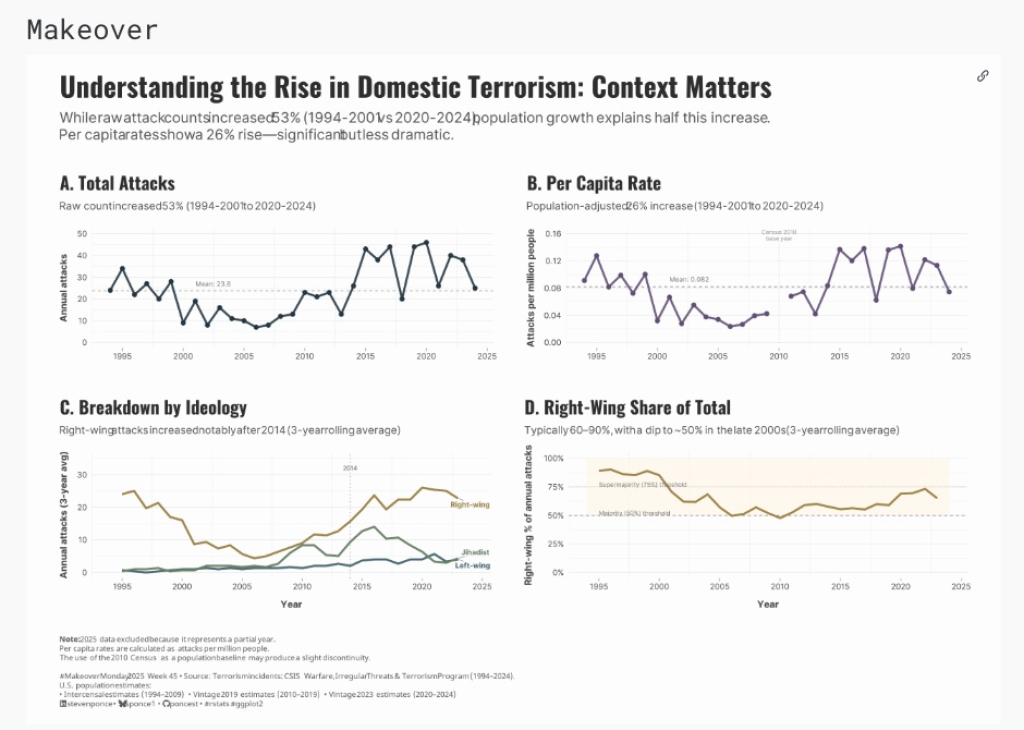
Stephen Ponce has created a compelling data visualization examining domestic terrorism trends in the United States. While raw attack counts show a 53% increase between 1994-2001 and 2020-2024, Ponce’s analysis reveals that population growth explains about half of this rise. When adjusted for population, the per capita rate shows a more nuanced 26% increase. This project is an excellent example of how high-quality data visualization can provide important context to headline statistics, and Ponce generously shares both the finished visualization and the complete code used to create it.
Databot on NHANES
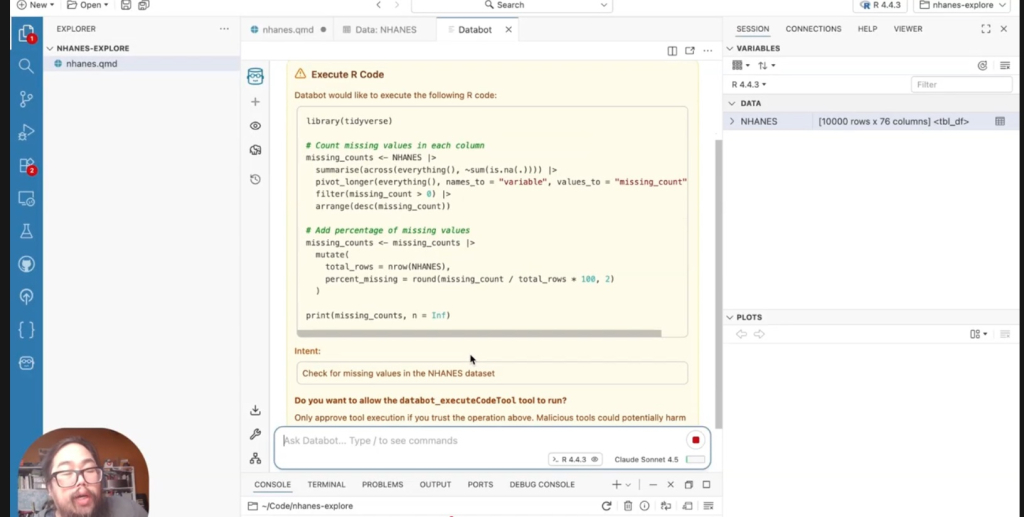
Ted Laderas introduces Databot, an experimental AI-powered analysis tool built into Positron (Posit’s new IDE for data science). In this video, Laderas demonstrates how Databot can accelerate exploratory data analysis by automatically writing and executing code to help you understand your data. Using the NHANES public health dataset as an example, he shows how this tool can dramatically speed up the initial stages of data exploration, turning what might take hours into a matter of minutes while keeping the data scientist in control of the process.
{quanteda}
The {quanteda} package offers a powerful approach to quantitative analysis of textual data. Developed by Kenneth Benoit and his team, {quanteda} provides tools for managing, processing, and analyzing text-based data in R. The package includes functions for creating document-feature matrices, working with dictionaries, tokenizing text, and performing various text analysis tasks. If you work with qualitative data and are looking for a code-based approach to text analysis, {quanteda} provides a comprehensive toolkit for transforming text into analyzable data.
If you enjoyed this issue of What’s New In R, please share it with a friend! And if they want to get What’s New in R directly in their inbox, they can sign up on the R for the Rest of Us website.
Got any ideas for resources I should feature in future issues of What’s New in R? Leave a comment below!
Sign up for the newsletter
Get blog posts like this delivered straight to your inbox.

You need to be signed-in to comment on this post. Login.