
What’s New in R: February 23, 2026
Welcome to this week’s edition of What’s New in R! This week, we’re featuring a journal article on spatial data science languages, Posit’s AI newsletter discussing Claude Code and coding agents, and the latest release of {stringr} with new case conversion functions. Let’s dive in!
Spatial data science languages: commonalities and needs
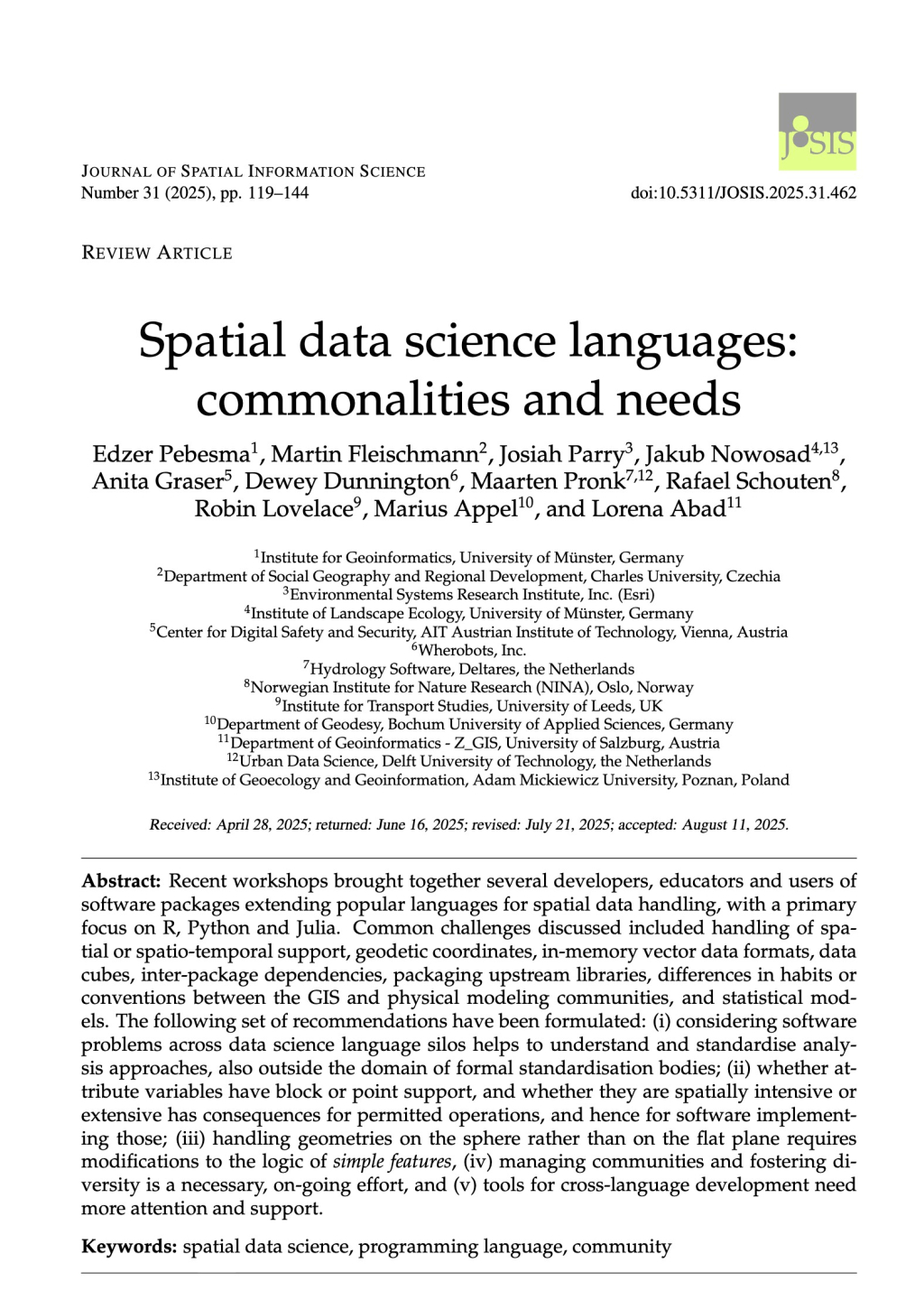
A distinguished team of spatial data science developers and educators, including Edzer Pebesma and Martin Fleischmann, published a comprehensive analysis comparing R, Python, and Julia for spatial data work. The article highlights R’s strengths in statistical analysis and its modern ecosystem centered around the {sf} package, which provides standards-based spatial data handling with tidyverse integration. The authors identify common challenges across all three languages—including handling geodetic coordinates, data cubes, and inter-package dependencies—and recommend that developers consider problems across language silos to better standardize spatial analysis approaches. The paper emphasizes the growing importance of tools like Apache Arrow and GeoArrow for cross-language spatial data interchange.
Posit's AI Newsletter

Posit’s latest AI newsletter highlights the rapid advances in coding agents, particularly Claude Code paired with the Opus 4.5 model. The newsletter introduces the concept of a “harness” or “scaffold”—the infrastructure that allows an LLM to behave as an effective agent—and notes that Opus 4.5 nearly doubled its accuracy when used with Claude Code compared to other harnesses. The post also discusses how organizations should integrate AI tools in ways that support their core values, with Posit emphasizing their focus on correct, transparent, and reproducible analyses. For R users, this is relevant context as AI-powered coding assistance becomes increasingly integrated into development workflows, including in tools like Positron.
stringr 1.6.0
Hadley Wickham announces the release of {stringr} 1.6.0, which introduces three new functions for converting between programming case conventions: str_to_camel(), str_to_snake(), and str_to_kebab(). These functions make it easy to transform strings like “my report” into different formats — camelCase, snake_case, or kebab-case — which is particularly useful for creating consistent file names or variable names programmatically. The release also includes performance improvements to str_replace_all() when using functions for replacements, ensures that {stringr} functions now preserve names on input vectors, and adds a new vignette on locale-sensitive functions. If you frequently work with strings in R, this update adds some handy new tools to your toolkit.
If you enjoyed this issue of What’s New In R, please share it with a friend! And if they want to get What’s New in R directly in their inbox, they can sign up on the R for the Rest of Us website.
Got any ideas for resources I should feature in future issues of What’s New in R? Leave a comment below!
Sign up for the newsletter
Get blog posts like this delivered straight to your inbox.

You need to be signed-in to comment on this post. Login.