
What’s New in R: May 11, 2026
Welcome to this week’s edition of What’s New in R! This week, we’re featuring a Claude Code skill for generating alt text for figures in Quarto, a video on building and automating serverless dashboards, and a behind-the-scenes look at how Kieran Healy used Quarto to write his data visualization book. Let’s dive in!
Adding alt text to figures in quarto with Claude Code
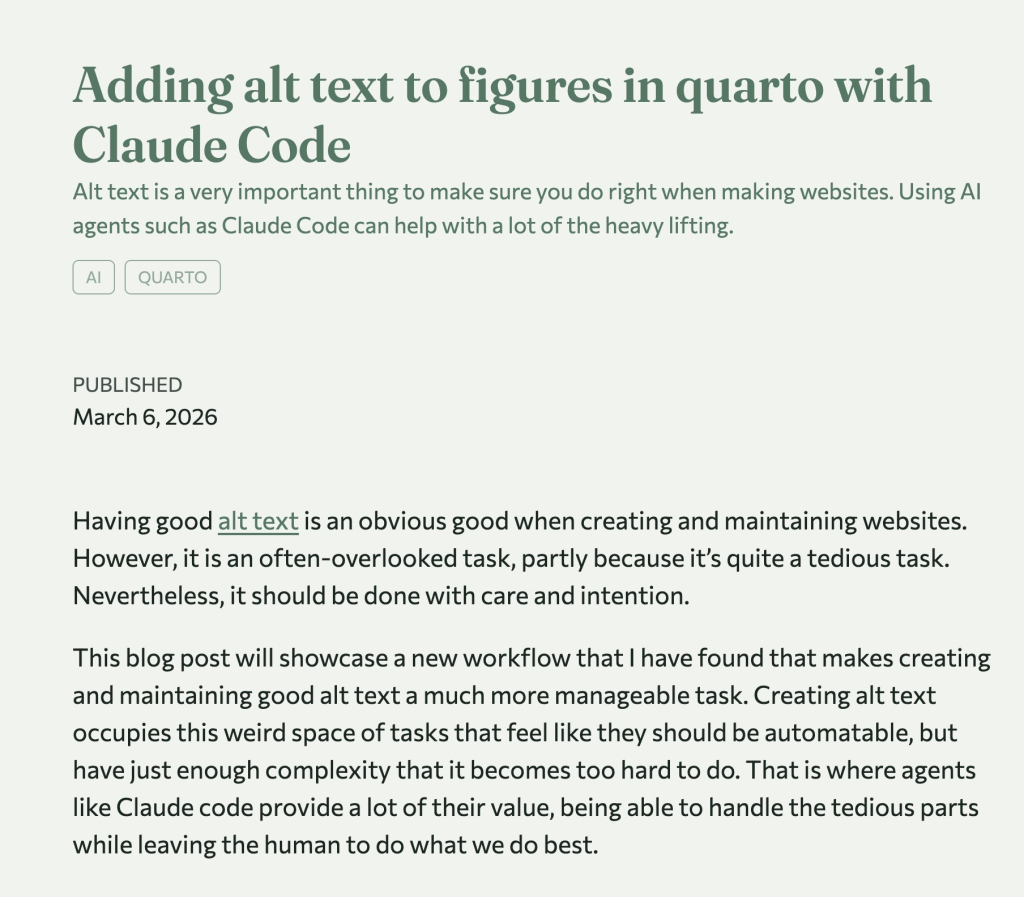
Emil Hvitfeldt demonstrates a workflow for automatically generating alt text for data visualizations in Quarto documents using a custom Claude Code skill. The approach works by analyzing both the R code generating figures and the rendered images themselves, applying Amy Cesal’s three-part formula—chart type, data description, and key insight—to produce consistent, accessible descriptions. A custom skill file (.claude/commands/write-chart-alt-text.md) handles the heavy lifting, and a supplementary Shiny app lets you review figures alongside their generated alt text side by side. It still requires human review, but dramatically cuts down the tedium of writing alt text from scratch.
How to Build and Automate Serverless Dashboards with R or Python
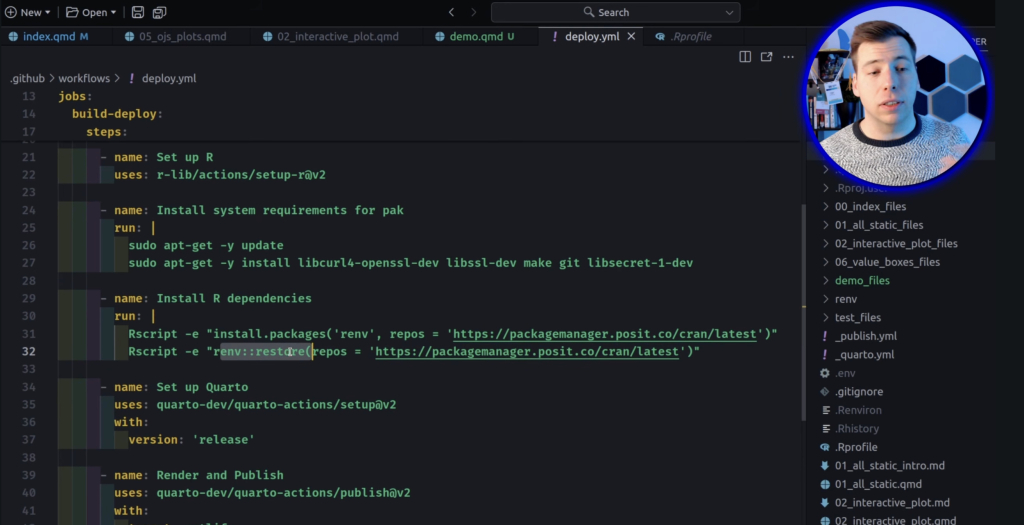
Albert Rapp walks through how to build serverless dashboards in R or Python and then automate their deployment using GitHub Actions. The video covers how to set up a dashboard that runs without a server, and then how to configure a GitHub Actions workflow so the dashboard redeploys automatically whenever you push changes to your repository. It’s a practical guide for anyone who wants to get a Quarto dashboard online without the overhead of managing a server—and without having to remember to redeploy manually every time something changes.
Using Quarto to Write a Book
Kieran Healy shares the behind-the-scenes story of how he used Quarto to write the second edition of Data Visualization: A Practical Introduction. He details his multi-format approach: a Tufte-style two-column PDF for the publisher with wide margins for sidenotes and figures, a responsive HTML version for the web, and an ePub—all generated from the same plain-text source files. He’s candid about where Quarto shines (roughly 85–90% of professional typesetting quality, automatically) and where final hand-adjustments from a professional typesetter are still worth it. If you’ve ever wondered about using Quarto for serious, long-form publishing work, this is a fascinating read.
If you enjoyed this issue of What’s New In R, please share it with a friend! And if they want to get What’s New in R directly in their inbox, they can sign up on the R for the Rest of Us website.
Got any ideas for resources I should feature in future issues of What’s New in R? Leave a comment below!
Sign up for the newsletter
Get blog posts like this delivered straight to your inbox.

You need to be signed-in to comment on this post. Login.