
What’s New in R: May 18, 2026
Welcome to this week’s edition of What’s New in R! This week, we’re featuring a package for accessing US price indexes in R, a deep dive into atmospheric light simulation for 3D visualizations, and a tool for generating synthetic data to safely share with AI assistants. Let’s dive in!
{realtalk}
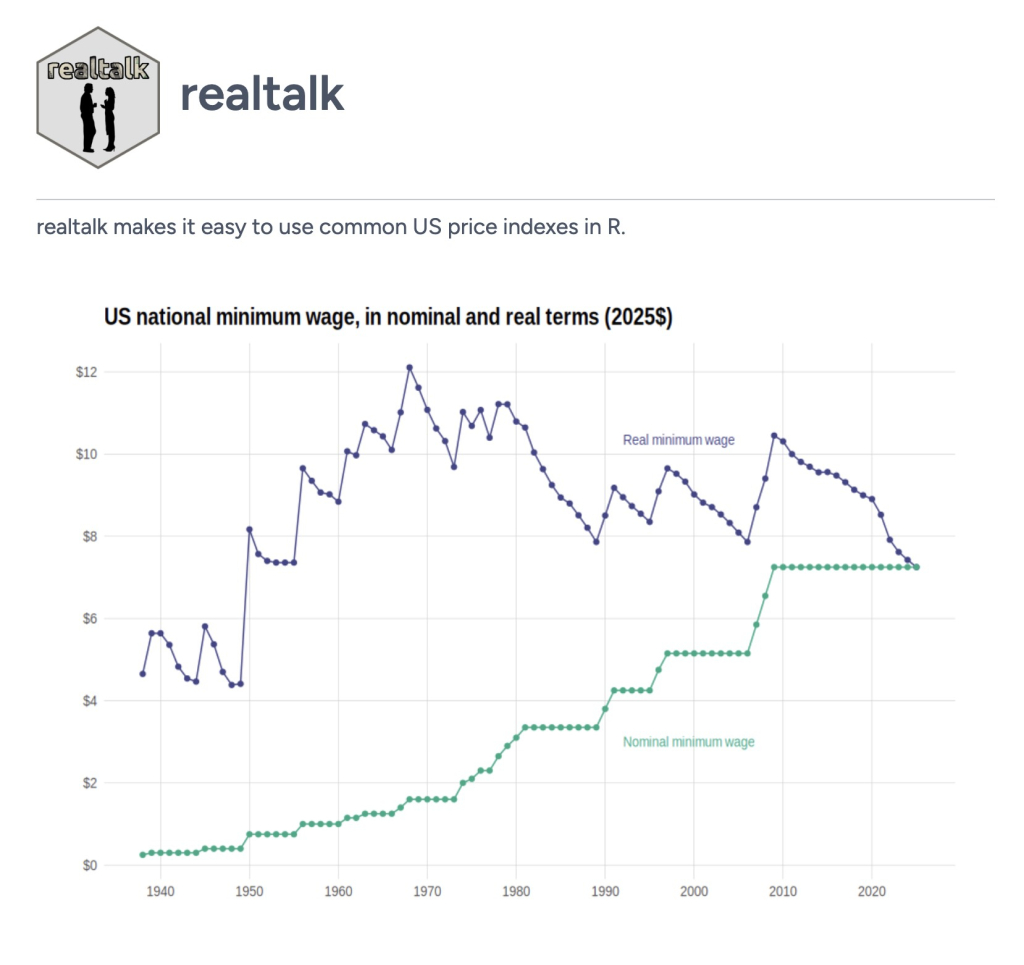
The {realtalk} package, developed by Ben Zipperer at the Economic Policy Institute, provides clean, ready-to-use access to five major US price indexes covering annual, monthly, and quarterly data with various seasonal adjustment options. Rather than navigating government websites and wrestling with raw files, you can load datasets directly by name or use the get_price_index() function to pull a specific series. An available_price_indexes table makes it easy to browse all 20 included datasets and their metadata. If US economic price data ever enters your analysis, this is a package worth knowing about.
Atmospheric Simulation in R
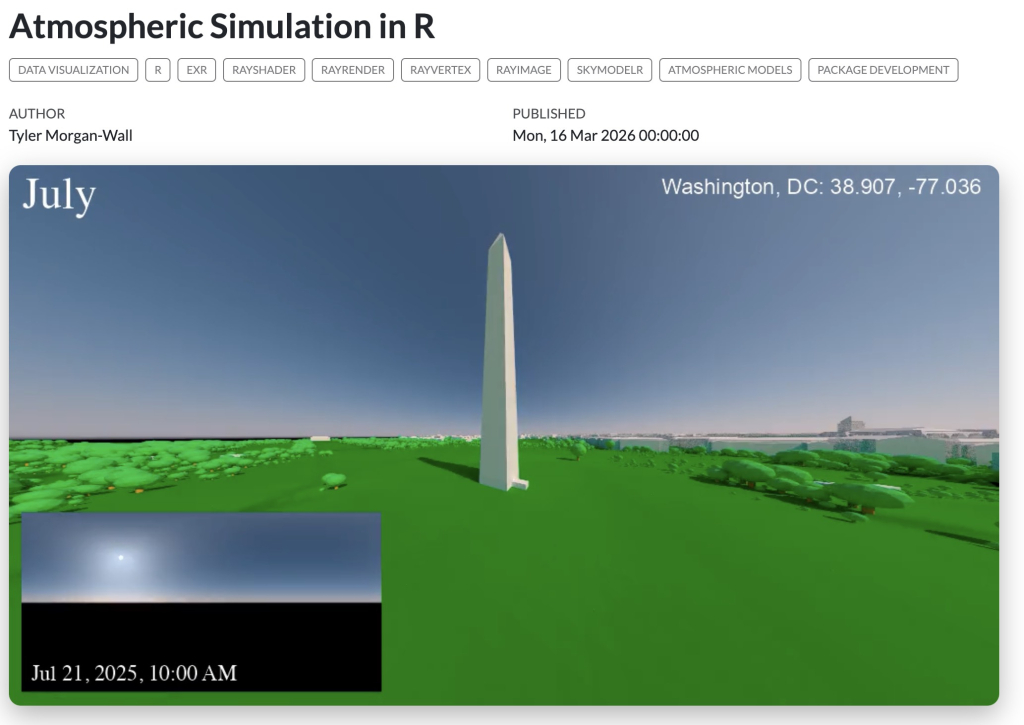
Tyler Morgan-Wall, creator of {rayshader}, explores how to generate realistic atmospheric lighting for 3D data visualizations in R. Rather than using multiple direct lights, which create harsh and overlapping shadows, he demonstrates how to simulate natural sunset lighting using {skymodelr}, a package that generates synthetic sky environments based on physical atmospheric models. Sunset lighting naturally achieves a “3:1 lighting ratio” that contours 3D shapes beautifully without visual clutter, and recent updates to {rayshader} let you simply specify a real-world latitude, longitude, and datetime to generate appropriate lighting automatically. It’s a technically rich post, but even if the physics goes over your head, the visuals make a compelling case for the difference thoughtful lighting makes.
{FakeDataR}
{FakeDataR}, created by Zobaer Ahmed, tackles a real pain point when using AI assistants for data work: how do you get help from an LLM without sharing sensitive data? The package generates synthetic copies of your dataframes that mirror the structure—column types, factor levels, numeric ranges, and missing data patterns—while replacing actual values with plausible fakes. Everything runs locally on your machine, sensitive fields like IDs, emails, and phone numbers are automatically detected and masked, and the package can export a ready-to-share bundle of fake data plus a JSON schema and guidance prompt for the LLM. It’s a simple but smart solution for getting AI assistance on real-world data without the privacy risk.
If you enjoyed this issue of What’s New In R, please share it with a friend! And if they want to get What’s New in R directly in their inbox, they can sign up on the R for the Rest of Us website.
Got any ideas for resources I should feature in future issues of What’s New in R? Leave a comment below!
Sign up for the newsletter
Get blog posts like this delivered straight to your inbox.

You need to be signed-in to comment on this post. Login.