
What’s New in R: May 4, 2026
Welcome to this week’s edition of What’s New in R! This week, we’re featuring an introduction to Posit AI for RStudio, the newly updated second edition of a beloved data visualization book, and a Quarto extension for displaying times in readers’ local time zones. Let’s dive in!
Introducing Posit AI
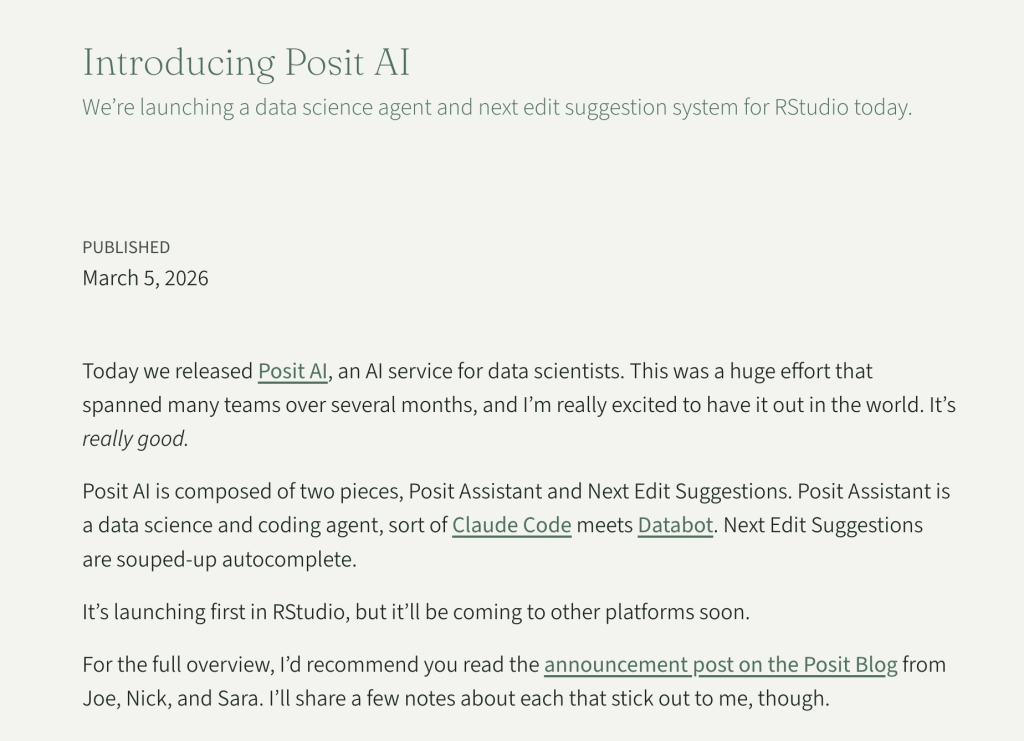
Simon P. Couch announces the arrival of Posit AI. It’s a new AI service built into RStudio that brings the kind of AI capabilities Positron users have enjoyed for a while to a much wider audience. Posit AI consists of two components: Posit Assistant, a context-aware coding and data science agent that lives inside your IDE, and Next Edit Suggestions, a fast autocomplete system powered by an 8-billion parameter model that predicts your next edit in milliseconds without hallucinating dataset names. Couch also gives a clear-eyed account of the real engineering work behind these features—permissions, tool UI, context management—making the case that building a great AI coding tool is much more than just wiring up an LLM. If you’ve been waiting for serious AI support to come to RStudio, check this out.
Data Visualization: A Practical Introduction
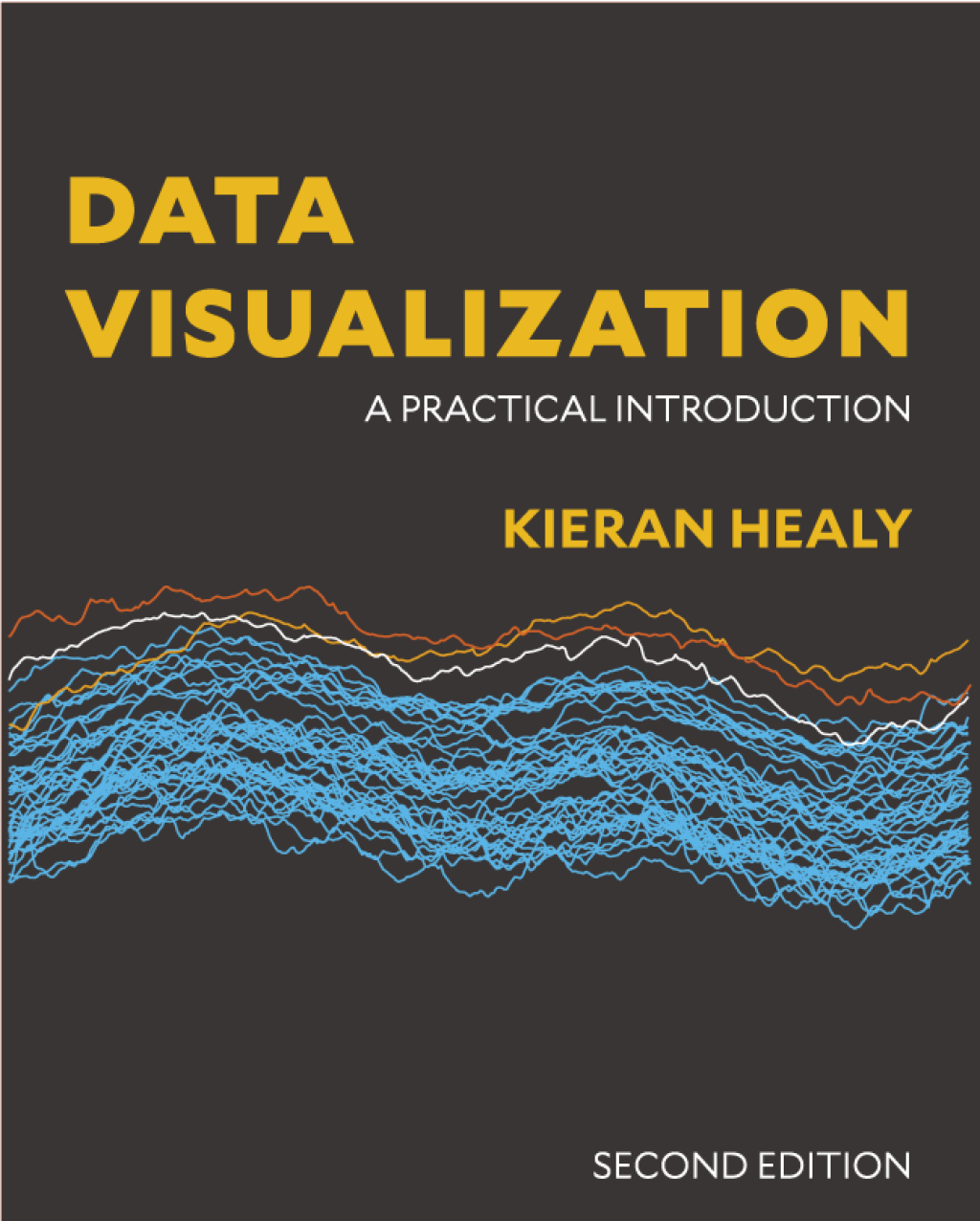
Kieran Healy’s Data Visualization: A Practical Introduction has long been one of the best resources for learning how to create effective graphics in R—and the thoroughly revised second edition is now available to read online ahead of its print release. The new edition is fully updated for R 4.5 and {ggplot2} version 4, adopts the native pipe operator |>, rewrites the chapters on statistical modeling and mapping using newer packages like {marginaleffects} and {sf}, and recommends Quarto over RMarkdown for document work. Whether you’re approaching data visualization for the first time or want to modernize your existing skills, this is the place to start.
localtime Quarto Extension
Ella Kaye has built localtime, a Quarto shortcode extension that displays a given time in each reader’s local time zone. Using a simple shortcode syntax, you specify a time and its source timezone, and JavaScript running in readers’ browsers automatically converts it to their local time—with graceful fallback text for when JavaScript is unavailable. The extension supports a wide range of timezone abbreviations and handles daylight saving time automatically. It’s a small addition to your Quarto toolkit, but if you’re publishing event times or coordinating across time zones, it’s exactly the kind of thing that saves a lot of confusion.
If you enjoyed this issue of What’s New In R, please share it with a friend! And if they want to get What’s New in R directly in their inbox, they can sign up on the R for the Rest of Us website.
Got any ideas for resources I should feature in future issues of What’s New in R? Leave a comment below!
Sign up for the newsletter
Get blog posts like this delivered straight to your inbox.

You need to be signed-in to comment on this post. Login.