
Resources
This carefully curated collection of resources will help you find packages and learning resources to help you on your R journey.

Introduction to web scraping
Stein Arne Brekke provides an introductory guide to web scraping judicial data in R, focusing on creating a dataset from UK Supreme Court decisions. Emphasizing empirical legal studies, the guide covers data gathering from online sources through programming. It offers a step-by-step process for scraping and organizing data into usable tables for research, using R. Beginners are pointed to additional learning resources, and the guide includes sections on scraping, data management, analysis, and legal considerations. It encourages sharing collected data to aid comparative legal research.
Go to Resource
LibreTranslate API for R: translate, detect languages
libretranslateR is an R package that provides a binding to the LibreTranslate API, enabling users to perform translation tasks, detect languages, and list available languages for translation, all from within R. The package includes a user-friendly wizard for configuration, and allows connections to any LibreTranslate instance, offering flexibility and offline translation capabilities by hosting your own instance. Currently not available on CRAN, it can be installed directly from GitHub via the 'remotes' package, and comes with features like auto-detection of languages, translation without leaving R, and future enhancements like file translation and more user-friendly language names.
Go to Resource
Positron’s AI-powered Databot Tool
Ted Laderas introduces Databot, an experimental AI-powered analysis tool built into Positron (Posit’s new IDE for data science). In this video, Laderas demonstrates how Databot can accelerate exploratory data analysis by automatically writing and executing code to help you understand your data. Using the NHANES public health dataset as an example, he shows how this tool can dramatically speed up the initial stages of data exploration, turning what might take hours into a matter of minutes while keeping the data scientist in control of the process.
Go to Resource

Quarto Extensions
This content presents a catalog of various Quarto extensions, complete with metadata such as the release date, author, version, and the number of stars on GitHub. The extensions cover a wide array of functionalities to enhance HTML documents, websites, blogs, books, and academic publications. Some specific features include embedding webR, minimalist themes for presentations, APA7 document formatting, countdown timers, inclusion of vector icons, and integration of interactive elements like Shinylive and code editors. The Quarto extensions support a diversity of outputs, such as PDF, HTML, and slides, and cater to needs in publishing, theming, and interactivity.
Go to Resource
resouRces
This content encompasses a comprehensive list of R-related educational materials, packages, tutorials, and datasets with projected dates ranging up to the year 2025. It includes various titles that focus on learning R programming, data analysis, data visualization, geospatial mapping, and statistical methods. Significant emphasis is placed on resources for learning R, such as introductions to R, books, courses, and video tutorials. Additionally, specific packages for data wrangling, statistical modeling, and visualization are mentioned, indicating the evolution and specialization of R's ecosystem to cater to diverse data science needs.
Go to Resource
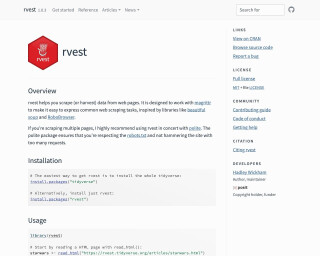
rvest
rvest is an R package that helps you scrape (or harvest) data from web pages. It is designed to work with magrittr to make it easy to express common web scraping tasks.
Go to Resource
shinymcp
shinymcp is a package that adapts Shiny applications for integration with AI chat interfaces such as Claude Desktop. It enables the creation of MCP Apps, which feature interactive UIs that run directly within chat conversations. To accomplish this, it restructures the traditional reactive programming model of Shiny into discrete tool functions that respond to user input changes. The package provides utilities for both manual and automatic conversion of existing Shiny applications. Developers can leverage familiar Shiny components, with the shinymcp bridge automatically detecting the connection between UI components and R code tools.
Go to Resource