
Resources
This carefully curated collection of resources will help you find packages and learning resources to help you on your R journey.
{FakeDataR}
{FakeDataR} is an R package that provides a local solution for creating synthetic copies of real datasets, preserving their structure, schema, types, and privacy. It prevents the risk of exposing sensitive data and is designed to support Large Language Model (LLM) workflows and reproducible sharing. The package includes heuristics for identifying sensitive fields, with the ability to fake or drop them, and supports exporting synthetic data along with a JSON schema and README prompt for LLM bundles. It's a suitable tool for creating quick, privacy-preserving synthetic data without the need for cloud processing.
Go to Resource
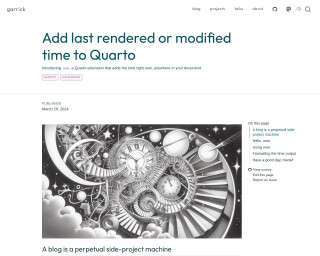
Add last rendered or modified time to Quarto
Garrick Aden-Buie's blog post introduces 'now,' a Quarto extension that allows the automatic update of time information in Quarto documents. This extension saves time by eliminating the need for manual updates of dates in documentation footers. By adding the extension using 'quarto add gadenbuie/quarto-now,' Quarto users can employ shortcodes like '{{< now >}}' and '{{< modified >}}' to display the current or last modified time. The extension supports customization of time output formats and may significantly streamline Quarto project maintenance by ensuring date accuracy without manual intervention.
Go to Resource

Advanced Reproducible Research in R
This content covers an advanced workshop titled 'Advanced Reproducible Research in R,' designed to teach collaborative and automated analysis pipelines in scientific research. It emphasizes the importance of reproducibility and open scientific practices, presenting solutions to challenges such as coding standards, software dependency documentation, and data analysis automation. The course uses a code-along format with real-world datasets, created with Quarto, GitHub, and GitHub Actions. The material is available on a website and the r-cubed-advanced GitHub repository, licensed under Creative Commons for open use and modification.
Go to Resource
Bluesky conversation analysis with local and frontier LLMs with R/Tidyverse
This content details the author's exploration of bluesky conversation analysis using R and the Tidyverse suite, specifically focusing on local and frontier large language models (LLMs). The author leverages R packages atrrr, ellmer in the tidyverse, mlverse/mall, and interfaces with models such as Claude & Ollama. Processes include summarizing posts, performing sentiment analysis, and posting summaries to GitHub via the gistr R package. Techniques include data retrieval, text analysis, and summarization, showcasing how open models can provide insights into community discussions on Bluesky, particularly within the R community's use of the #Rstats hashtag.
Go to Resource
Creating Polished, Branded Documents with Quarto
Isabella Velásquez from Posit delivers a comprehensive R/Pharma workshop on creating polished, professionally branded documents using Quarto. The talk covers Quarto’s key outputs—documents, presentations, websites, dashboards, and PDFs—and focuses heavily on theming and branding, including the use of brand.yml to define and apply consistent visual identities (colors, fonts, logos) across all output formats from a single configuration file.
Go to Resource
Data Pipelines with {targets}
This content introduces the 'targets' R package, designed to assist in creating reproducible and efficient data pipelines. 'targets' tracks each component of an analytical pipeline, updating steps only when changes occur and avoiding redundant computations. It facilitates clean, function-oriented code that significantly reduces frustration and time spent on re-running analyses due to errors or alterations in the code. The post includes a simple analysis example using the 'palmerpenguins' dataset, demonstrating how 'targets' can streamline the workflow. The analogy to The Eye of Sauron exemplifies its vigilant tracking capability.
Go to Resource
Duplicating Quarto elements with code templates to reduce copy and paste errors
This blog post from the Water Data For The Nation Blog demonstrates how to use Quarto code templates to create reproducible Quarto documents, such as reports and slideshows, with fewer errors. Using custom templates allows for the easy replication of code chunks, such as those producing statistical summaries or visualizations for different datasets. The example used is USGS streamgage data, with a focus on automating the creation of slideshows in Quarto's markdown format. Advanced topics like adding columns, tables, and speaker notes to PowerPoint slides via Quarto are also covered. Methods for iterating over data in a more efficient and less error-prone way than traditional copy and paste techniques are highlighted.
Go to Resource
Easily download files from the Open Science Framework with Papercheck
The 20% Statistician is a blog focusing on statistics, research methods, and open science. It aims to help researchers understand crucial statistical concepts, claiming that grasping 20% of statistics can improve 80% of inferences. A recent post highlights the challenge of downloading files from the Open Science Framework (OSF). The authors, DeBruine and Lakens, introduced 'Papercheck,' an R package with a function 'osf_file_download' that simplifies this process. Papercheck recreates OSF's folder structure within a local directory, making it user-friendly to access project files for review or reuse.
Go to Resource
How (and Why) I came to Use R for Data Analysis and Evaluation
Alberto Espinoza recounts his journey with R for data analysis and evaluation, marking his 10-year experience since first encountering R during his graduate assistantship. Initially clueless about R, he was tasked with assisting and leading statistics labs using R. Despite early challenges and a steep learning curve, he recognized R's power over software like SPSS or Excel. His continued use of R spanned graduate projects, market research, data preparation for Tableau, and Survey Monkey analysis. Espinoza outlines R's advantages: reproducibility, efficiency, clarity, and an extensive package ecosystem, underlining R's significance in his professional growth.
Go to Resource
Optimising VS Code and Positron for Quarto
This content presents a comprehensive guide to optimizing the editing experience of Quarto documents within VS Code and Positron platforms. It details specific editor settings adjustments aimed at improving document editing by addressing common issues such as code formatting, readability, and workspace performance. The settings enhance visual assistance, reduce visual clutter, manage markdown table rendering, and refine Git diffs. Essential configurations such as defining language-specific settings, modifying word wrapping, and utilizing bracket pair guides are discussed. Additionally, recommendations for visual line length guides, workspace performance optimization, and GitHub Copilot integration for AI assistance are provided to streamline the Quarto document editing workflow.
Go to Resource
Posit AI Newsletter
Posit's blog for August 29, 2025, announces the publication of an AI newsletter curated by Sara Altman and Simon Couch, previously internal, now available biweekly. The newsletter discusses significant AI developments including environmental reports on LLMs by Mistral AI and Google, and introduces Positron Assistant and Databot for R/Python coding and data analysis. It raises awareness about the energy demands of AI during training and inference stages, emphasizes responsible AI tool usage, and shares external insights and resources on AI advancements and security vulnerabilities with the data science community.
Go to Resource

Quarto for Scientists
Quarto for Scientists is an educational material designed to teach scientists how to create reproducible reports using Quarto with R Markdown. It covers installation, workflow, and various features such as figure and table management, equations, bibliographies, and debugging. Initially a 3-hour workshop, it has evolved into a living book, providing a structured learning experience. With Quarto, scientists can integrate code, text, and figures into one file, enabling anyone to reproduce their research with the provided datasets and Quarto files. Nicholas Tierney authored this resource to fill a niche in R Markdown education for scientists.
Go to Resource