
Resources
This carefully curated collection of resources will help you find packages and learning resources to help you on your R journey.
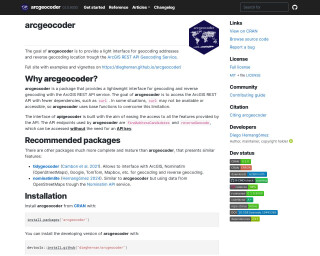
{arcgeocoder} package for geocoding
arcgeocoder is an R package that serves as a lightweight interface for geocoding and reverse geocoding using the ArcGIS REST API Geocoding Service. It allows R users to easily convert addresses to geographic coordinates and vice versa without needing an API key. The package is designed to work with base R functions, avoiding dependencies like curl, making it accessible in environments where curl isn't available. arcgeocoder is advantageous when quick and simple access to geocoding services is needed, and it includes functions like arc_geo() for geocoding and arc_reverse_geo() for reverse geocoding.
Go to Resource
{datapasta} came up at #CascadiaRconf
Libby Heeren highlights the {datapasta} R package, particularly useful for copying tables from various sources and pasting them into R as a tibble or other data structures. She praises the package's efficiency and its contribution to reproducibility in data handling. The community shares positive feedback, with many expressing a desire to use the package for its convenience and reproducibility benefits. An updated version is recommended from GitHub, as the CRAN version is not the latest. The post indicates a strong appreciation for {datapasta} within the R community.
Go to Resource
{FakeDataR}
{FakeDataR} is an R package that provides a local solution for creating synthetic copies of real datasets, preserving their structure, schema, types, and privacy. It prevents the risk of exposing sensitive data and is designed to support Large Language Model (LLM) workflows and reproducible sharing. The package includes heuristics for identifying sensitive fields, with the ability to fake or drop them, and supports exporting synthetic data along with a JSON schema and README prompt for LLM bundles. It's a suitable tool for creating quick, privacy-preserving synthetic data without the need for cloud processing.
Go to Resource

{ggborderline}
The ggborderline package enhances ggplot2 line plots with geoms that add an outlined effect, improving clarity for plots with overlapping lines. It's ideal for visualizing 'worm' style data. Users can replace ggplot2 line geoms with border equivalents to achieve a white outline where lines intersect, with settings for borderwidth and bordercolour these subtle enhancements can be adjusted. Additionally, the package makes the borders visible in the plot's legend. Installation instructions include CRAN and GitHub options, inspired by a need to avoid indistinct lines in complex visualizations, offering an aesthetic alternative to ggplot2's capabilities.
Go to Resource
{legendry}
The 'legendry' package is a new ggplot2 extension for improving guide options in R plots, now available on CRAN. It provides tools for flexible and reproducible placement of annotations within figures, avoiding the need for post-editing in external software. Originating from the author's earlier work on 'ggh4x', 'legendry' enhances guides in ggplot2 by using the ggproto system. The package includes vignettes and aims to simplify the customization of scale guides. With 'legendry', users can introduce manual keys and complete guides, such as 'guide_axis_nested' for ranges or 'guide_legend_groups' for groups, thereby expanding visualization capabilities.
Go to Resource

{Ra11y} package: Collection of accessibility functions for R
Ra11y is a public GitHub repository created by user nicucalcea, which hosts a collection of accessibility functions designed for R programming. The project aims to enhance accessibility within R and contains resources for developers to utilize these functions in their work. With 18 stars and 1 fork, the repository appears to be modestly popular within the community. The repository is fully coded in R and provides documentation to help users understand and implement the functions for their accessibility needs.
Go to Resource

10 years of rio
This is a blog post titled '10 years of rio' by Chung-hong Chan. It discusses the history and development of the R language package 'rio', which is similar to stringr. The author talks about the motivation behind creating the package and the design principles used. The package provides functions for importing and exporting data in various formats, with a consistent API. The post also mentions the compatibility of the package with older versions of R.
Go to Resource
A Comprehensive Collection of Crime-Related Datasets • crimedatasets
The crimedatasets package in R provides an extensive array of crime-related datasets. It's tailored for users interested in crime analysis, criminology, and studying socio-economic factors related to criminal activity. It offers a broad range of data types including tables, tibbles, spatial data, and time series, each with a specific naming convention for ease of use. Installation is straightforward via CRAN, and the package puts various global and local crime datasets at one's fingertips for research and educational purposes, such as datasets on US cybersecurity breaches and New Zealand murders.
Go to Resource
A Comprehensive Collection of U.S. Datasets • usdatasets
The usdatasets package provides an essential collection of U.S.-specific datasets suitable for analysis in various fields like crime, economics, education, and healthcare. It includes datasets with suffixes denoting their type, aiding in identification and usage. The package can be installed from CRAN and is easy to use, making it a valuable tool for researchers and analysts working with U.S. data. It follows a consistent naming convention to indicate data structures, such as time series (_ts) or data frames (_df), simplifying the data analysis process.
Go to Resource
Access and Manipulate Comprehensive Country Level Data in Tidy Format • tidycountries
The tidycountries package in R provides a comprehensive interface for accessing and manipulating country-level data. It includes details such as names, regions, populations, currencies, and more in a tidy format that integrates with the tidyverse. It's useful for global research, visualizations, and querying country information. The package can be easily installed from CRAN or GitHub and integrates well with the tidyverse, making data manipulation straightforward.
Go to Resource
Access South Korean Data via Public APIs and Curated Datasets • SouthKoreAPIs
The SouthKoreAPIs package is a comprehensive R tool for accessing South Korean open data from various public APIs and curated datasets. It interfaces with the World Bank API, Nager.Date API, and REST Countries API to fetch a range of information, such as economic indicators and national holidays. Additionally, it boasts an extensive collection of datasets encompassing public health, demographics, social surveys, and more. Its utility functions facilitate the retrieval of specific data points, like mortality rates and GDP, while its organized datasets enable in-depth analysis of South Korean socioeconomic and cultural patterns.
Go to Resource
Air 0.7.0
Air 0.7.0 is a newly released version of a powerful R formatter known for its speed, announced by Davis Vaughan and Lionel Henry. It includes updates from versions 0.5.0 to 0.7.0 with enhanced Positron support, a 'autobracing' feature for formatting code blocks, and a GitHub Action for automation. The Air extension comes bundled with Positron, ensuring automatic updates and a seamless experience. The release simplifies adding Air to projects with usethis::use_air(), formatting configuration, and the promotion of consistent coding styles across various editors. It also introduces autobracing for if statements and loops to improve code portability.
Go to Resource