
Resources
This carefully curated collection of resources will help you find packages and learning resources to help you on your R journey.
Introducing Posit AI
Simon P. Couch announces the release of Posit AI, a new AI service for data scientists, which comprises Posit Assistant and Next Edit Suggestions. Posit Assistant acts as a data science and coding agent, combining aspects of Claude Code with Databot, offering users a sophisticated coding experience. Next Edit Suggestions provide advanced autocomplete capabilities and are initially available in RStudio, with plans to extend to other platforms. Simon highlights the effort put into making Posit AI practical for everyday use and mentions the upcoming detailed post about the Next Edit Suggestions system.
Go to Resource

Keep your packages up-to-date with minimal hassle
{updateme} is an R package that enhances the library() function by displaying informative messages about the current status of loaded packages with respect to their latest versions. It supports packages installed from CRAN, Bioconductor, GitHub, and GitLab. The tool provides configurations for checking updates and can be easily integrated into the R startup process. The package also features caching mechanisms to improve performance and can be toggled on or off as needed. It's designed to help R users keep their packages up-to-date with minimal hassle.
Go to Resource
Large Language Model tools for R
This guide, written by Luis D. Verde Arregoitia and published on February 16, 2026, focuses on Large Language Model (LLM) tools specifically designed for usage with the R programming language. It provides an updated roundup of various tools and developments in the LLM and genAI space, including new R packages like interactive code review, predictive modeling assistant, AI coding agent CLI, prompt-building framework with validation, automated data analysis architecture, and native R interfaces to Hugging Face models and datasets. Other tools like a CLI extension with IDE integration are also mentioned. The guide aims to facilitate users, especially those in R communities, by tracking and summarizing the latest useful resources.
Go to Resource
Large Language Model tools for R
This guide serves as a roundup of Large Language Model (LLM) and general AI tools specifically for R users, written by Luis D. Verde Arregoitia. It includes the latest developments in the LLM/genAI space as of June 2025, with resources such as chatting with OpenAI models within RStudio using PacketLLM, model context protocol with mcpr, and image generation with diffuseR. The content is designed for teaching and tracking updates in LLM+R tools. It is presented in an easy-to-navigate book format, which will be periodically updated to reflect changes in the fast-moving field.
Go to Resource
Lotas - AI for RStudio | Rao Code Editor
Rao Code Editor by Lotas is an AI-powered tool designed to enhance the RStudio workflow. It offers an intelligent code editor that understands project files and data, enabling it to generate and edit code efficiently. Rao writes R scripts and R markdown files, fixes errors, and improves analyses. It also comprehensively analyzes output, including console results and data visualizations, providing suggestions and insights into the code's implications. Available with a free tier, Rao aims to streamline the coding process for RStudio users.
Go to Resource
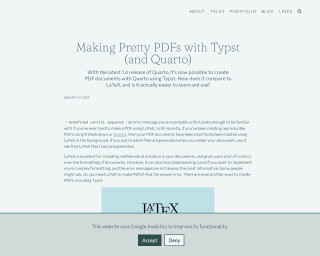
Making Pretty PDFs with Typst (and Quarto)
Nicola Rennie's article explores the benefits of the new Typst system for creating PDFs with Quarto. Typst is an alternative to LaTeX that aims to be easier to learn and more user-friendly. The article provides a guide on how to use Typst with Quarto, including setting the formatting and creating custom styles. It addresses the challenges of learning Typst by sharing personal experiences and comparing code snippets between Typst and LaTeX. The focus is on enhancing the appearance of PDF documents while maintaining reproducibility and control over the formatting.
Go to Resource
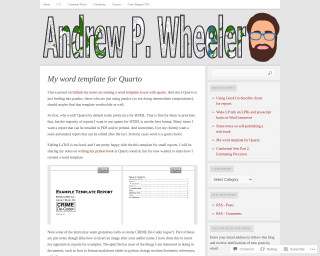
My word template for Quarto | Andrew Wheeler
Andrew Wheeler's blog post discusses creating a custom Word template for use with Quarto, which is beneficial for reports that require formatting suitable for email, printing, or post-generation editing. Starting with the command to generate a default Word template from Quarto, Wheeler explains how to modify styles for various document elements like titles, headings, and code snippets. The template supports markdown tables and features styling for page numbers, headers, and footers. His template also includes personal branding with a hyperlinked logo. The post is a resource for those who prefer Word over HTML or LaTeX for their Quarto-generated documents.
Go to Resource
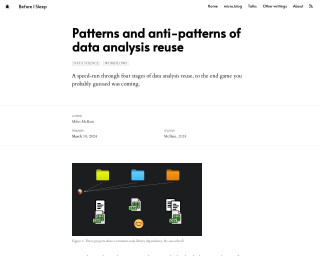
Patterns and anti-patterns of data analysis reuse
The blog post titled 'Before I Sleep: Patterns and anti-patterns of data analysis reuse' by Miles McBain discusses the common themes in data analysis roles pertaining to the repeated nature of certain analyses across various industries. McBain highlights the need for reusing code and strategies efficiently to maintain productivity amidst this recurring challenge. The text delves into different stages of data analysis reuse, such as copy-pasting previous work, which may initially save time but lead to accruing technical debt. It stresses on setting up practices for swift reuse of work to build upon proven capabilities, assuming the work is code-based and document-like products are code-generated.
Go to Resource
Posit AI Newsletter
Posit's blog for August 29, 2025, announces the publication of an AI newsletter curated by Sara Altman and Simon Couch, previously internal, now available biweekly. The newsletter discusses significant AI developments including environmental reports on LLMs by Mistral AI and Google, and introduces Positron Assistant and Databot for R/Python coding and data analysis. It raises awareness about the energy demands of AI during training and inference stages, emphasizes responsible AI tool usage, and shares external insights and resources on AI advancements and security vulnerabilities with the data science community.
Go to Resource
Posit Generative AI Solutions
Posit GenAI Solutions offers versatile packages for integrating LLMs into R and Python. It features ellmer and chatlas for LLM communication, shinychat for chatbots in Shiny, and ragnar for Retrieval-Augmented Generation. Additional tools include querychat for natural language data querying, chores for automating coding tasks, and gander for in-line chat integration in data science workflows. The mall package efficiently applies LLM predictions to data frames, while lang translates documentation. Positron Assistant and GitHub Copilot enhance IDEs with AI. Packages like otel provide observability via OpenTelemetry, and mcptools implements the MCP for R sessions.
Go to Resource
Positron Assistant: GitHub Copilot and Claude-Powered Agentic Coding in R
Positron Assistant is a tool that integrates with GitHub Copilot and Anthropic Claude to offer advanced code completion and interaction for R programming. It provides a seamless experience for users switching from RStudio by offering a comprehensive feature set, including remote SSH sessions. With Positron Assistant, users can generate or refactor code, ask questions, get debugging assistance, and receive project guidance within the Positron environment. It simplifies the process of creating R packages, documenting with Roxygen2, and writing unit tests with testthat, demonstrating its capability through agent mode.
Go to Resource
Privacy and AI Assistants
This blog post by Simon Couch and Sara Altman from Posit discusses the integration of privacy concerns with AI assistants. It provides insights into how AI technology, especially large language models (LLMs), can align with privacy standards. Simon Couch, a software engineer with expertise in R and LLMs, shares his experiences in developing packages for R that enhance LLM capabilities. Additionally, Sara Altman, a data science educator, highlights the resources available through Posit for open-source data science. The post emphasizes the importance of privacy in AI as these technologies become more prevalent in data analysis and software development.
Go to Resource