
Resources
This carefully curated collection of resources will help you find packages and learning resources to help you on your R journey.
Qualitative Analysis with Large Language Models • quallmer
The quallmer package leverages AI, particularly large language models, for qualitative data analysis. It assists researchers in coding texts, images, PDFs, tabular, and structured data. quallmer simplifies AI-assisted qualitative coding, ensuring the quality and reliability of AI-generated codes with functions for codebook creation, coding, comparison, validation, replication, and documenting audit trails. It supports all LLMs available with the ellmer package and includes a Shiny app for an interactive experience.
Go to Resource
Rapid RAG Prototyping
Rapid RAG Prototyping leverages the power of R through the ellmer package and DuckDB to build a Retrieval-Augmented Generation (RAG) prototype, enhancing a large language model with domain-specific knowledge. This solution addresses the limitations of large language models, which often lack current or specific information. The ellmer package provides an interface for working with various LLM providers, adding functions like tool calling and data extraction. DuckDB contributes with high-performance data processing, enabling efficient query handling. Together, they offer a formidable toolkit for fast prototyping of LLM-powered applications.
Go to Resource
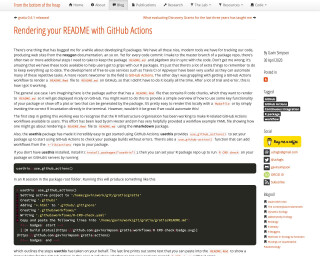
Rendering your README with GitHub Actions
This tutorial explains how to use GitHub Actions to automatically render your README.Rmd file to README.md on GitHub.
Go to Resource
resouRces
This content encompasses a comprehensive list of R-related educational materials, packages, tutorials, and datasets with projected dates ranging up to the year 2025. It includes various titles that focus on learning R programming, data analysis, data visualization, geospatial mapping, and statistical methods. Significant emphasis is placed on resources for learning R, such as introductions to R, books, courses, and video tutorials. Additionally, specific packages for data wrangling, statistical modeling, and visualization are mentioned, indicating the evolution and specialization of R's ecosystem to cater to diverse data science needs.
Go to Resource
shinymcp
shinymcp is a package that adapts Shiny applications for integration with AI chat interfaces such as Claude Desktop. It enables the creation of MCP Apps, which feature interactive UIs that run directly within chat conversations. To accomplish this, it restructures the traditional reactive programming model of Shiny into discrete tool functions that respond to user input changes. The package provides utilities for both manual and automatic conversion of existing Shiny applications. Developers can leverage familiar Shiny components, with the shinymcp bridge automatically detecting the connection between UI components and R code tools.
Go to Resource
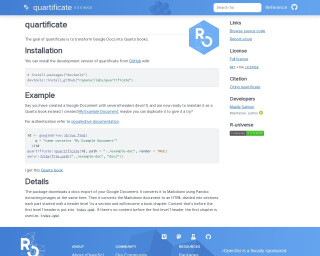
Transform Google Docs into Quarto Books with {quartificate}
The 'quartificate' package is designed to convert Google Documents into Quarto books, facilitating the transition from a simple document to a structured and maintainable book format. It streamlines the process by exporting the document into a Docx file, converting it to Markdown via Pandoc, and then sectioning it into HTML chapters based on header levels. This enables users to easily manage and render their content as a Quarto book. The package also provides seamless integration with Googledrive for authentication and document retrieval, and offers a quick start to render and view the book using the 'servr' package.
Go to Resource
Writing beautiful code
This content is a comprehensive guide on writing aesthetically pleasing and maintainable code, with a focus on R programming. The author, Ma"elle Salmon, explains the importance of beautiful code for readability and collaboration. The guide includes practical tips and tricks, and emphasizes adherence to coding styles, proper spacing, avoiding overly long lines, and creating descriptive functions. Additionally, the author discusses reducing unnecessary comments and documenting functions effectively. The guide also covers using tools like {styler} for automatic formatting and encourages learning from others' code to extend one's R vocabulary.
Go to Resource