
Resources
This carefully curated collection of resources will help you find packages and learning resources to help you on your R journey.
Listening to complex tones using sine waves and toneR
The post details an experiment with auditory perception by converting chord patterns into complex tones through programming. Matt Crump describes using the R package {toneR} to synthesize chords as sums of sine waves at varying frequencies and amplitudes, resulting in complex tonal renderings. Initial code examples involve AI model 'Dreamshaper' generating art from prompts, with a musical focus. Subsequently, the tutorial shifts to R code for audio synthesis and processing. This exploration rekindles the author's previous academic work on complex tones and their perceptual effects, inviting readers to join in the auditory experiment.
Go to Resource
Lotas - AI for RStudio | Rao Code Editor
Rao Code Editor by Lotas is an AI-powered tool designed to enhance the RStudio workflow. It offers an intelligent code editor that understands project files and data, enabling it to generate and edit code efficiently. Rao writes R scripts and R markdown files, fixes errors, and improves analyses. It also comprehensively analyzes output, including console results and data visualizations, providing suggestions and insights into the code's implications. Available with a free tier, Rao aims to streamline the coding process for RStudio users.
Go to Resource
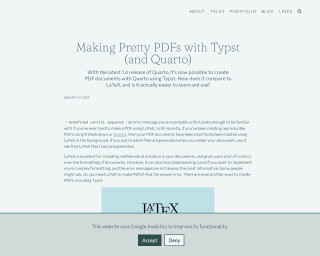
Making Pretty PDFs with Typst (and Quarto)
Nicola Rennie's article explores the benefits of the new Typst system for creating PDFs with Quarto. Typst is an alternative to LaTeX that aims to be easier to learn and more user-friendly. The article provides a guide on how to use Typst with Quarto, including setting the formatting and creating custom styles. It addresses the challenges of learning Typst by sharing personal experiences and comparing code snippets between Typst and LaTeX. The focus is on enhancing the appearance of PDF documents while maintaining reproducibility and control over the formatting.
Go to Resource
New, work-in-progress book on spatial data visualization in R
This is an announcement of a work-in-progress book titled Spatial Data Visualization with tmap: A Practical Guide to Thematic Mapping in R, to be published on October 14, 2025. The book is designed for various levels of expertise, from beginners to experienced GIS users and covers the usage of the tmap package in R for creating thematic maps. The online version is currently available, with the first three parts mostly complete, and further chapters in development. The tmap package has seen significant updates in version 4.0, adding features like improved defaults and expanded faceting options. The book is part of the geocompx project.
Go to Resource
Notes from a data witch - Four ways to write assertion checks in R
Learn about four different approaches to writing assertion checks in R to ensure code fails loudly and throws an error when assumptions are violated.
Go to Resource
Notes from a data witch - Four ways to write assertion checks in R
This article discusses the importance of writing assertion checks in R to ensure code fails loudly and throws an error when assumptions are violated. It explores four different approaches to writing assertions in R, with examples and explanations.
Go to Resource
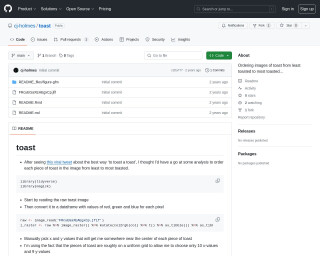
Ordering images of toast from least toasted to most toasted...
The GitHub repository 'toast' by cj-holmes is a unique project that involves organizing images of toast based on their level of toasting, from least to most toasted. It provides an analytical approach to the humorous question of the best way to 'toast a toast' using R and ImageMagick. The repository includes code to read and analyze an image of toast, select pixel values, and visualize them to identify the level of toasting. It leverages packages from the tidyverse and uses ggplot for visualization and magick for image processing to create a greyscale intensity from RGB values of pixels.
Go to Resource
Positron Assistant: GitHub Copilot and Claude-Powered Agentic Coding in R
Positron Assistant is a tool that integrates with GitHub Copilot and Anthropic Claude to offer advanced code completion and interaction for R programming. It provides a seamless experience for users switching from RStudio by offering a comprehensive feature set, including remote SSH sessions. With Positron Assistant, users can generate or refactor code, ask questions, get debugging assistance, and receive project guidance within the Positron environment. It simplifies the process of creating R packages, documenting with Roxygen2, and writing unit tests with testthat, demonstrating its capability through agent mode.
Go to Resource
R Primers
R Primers offer updated RStudio/Posit educational content, now utilizing Quarto and webR. Originally developed by RStudio/Posit Education Team, these open-source tutorials help users learn R programming, deriving content from the book 'R for Data Science'. They are licensed under the CC BY-SA 4.0, ensuring wide accessibility for learners to improve their data science skills with R.
Go to Resource
Reproducible Data Science in R: Writing functions that work for you
This blog post from the Water Data For The Nation Blog guides readers on crafting custom functions in R for reproducible data science, particularly with water-related data. Starting from the basics, it emphasizes the benefits like consistency, error reduction, and code shortening by avoiding repeated tasks. The post covers function essentials and environments in R, providing a step-by-step tutorial using the Water Quality Portal data. It prepares readers for advanced function usage in R, targeting those with basic programming experience aiming to advance their skills.
Go to Resource
resouRces
This content encompasses a comprehensive list of R-related educational materials, packages, tutorials, and datasets with projected dates ranging up to the year 2025. It includes various titles that focus on learning R programming, data analysis, data visualization, geospatial mapping, and statistical methods. Significant emphasis is placed on resources for learning R, such as introductions to R, books, courses, and video tutorials. Additionally, specific packages for data wrangling, statistical modeling, and visualization are mentioned, indicating the evolution and specialization of R's ecosystem to cater to diverse data science needs.
Go to Resource
RStudio Cloud Primer: Functions
Posit Cloud is a cloud-based platform for managing and analyzing data in the financial services industry.
Go to Resource