
Resources
This carefully curated collection of resources will help you find packages and learning resources to help you on your R journey.
How to write your own R package and publish it on CRAN
A tutorial on how to write your own R package and publish it on CRAN
Go to Resource
I Made R Text For Me
Brenden Smith shares his experience tackling procrastination in his personal life by using R to automate monthly utility bill calculations and notifications for his roommates. He created an R script connected to a Google Sheets spreadsheet to automatically handle and split the bills, and even set up cron jobs to ensure the process runs without his intervention. His project shows how programming can be applied to simplify and optimize mundane tasks, turning them into efficient, automated systems.
Go to Resource
I Vibe Coded an R Package
Jonathan Carroll documents his journey of creating an R package to visualize similar kanji characters. After starting to learn Japanese with his daughter, he couldn't find an existing solution to visually compare kanji characters for his studies. Utilizing Claude Code, Carroll developed a package in just $20 and one afternoon, complete with full documentation, mocked tests, API coverage, caching, and graph visualizations. The resulting network diagram displays kanji with similarities, aiding memory and recognition. This personal project showcases an efficient approach to language learning tool development in R.
Go to Resource

Keep your packages up-to-date with minimal hassle
{updateme} is an R package that enhances the library() function by displaying informative messages about the current status of loaded packages with respect to their latest versions. It supports packages installed from CRAN, Bioconductor, GitHub, and GitLab. The tool provides configurations for checking updates and can be easily integrated into the R startup process. The package also features caching mechanisms to improve performance and can be toggled on or off as needed. It's designed to help R users keep their packages up-to-date with minimal hassle.
Go to Resource
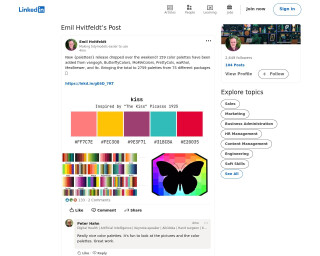
New {paletteer} release dropped over the weekend! 159 color palettes have been added
The content discusses Emil Hvitfeldt's LinkedIn post about a new release of the {paletteer} R package, which added 159 color palettes, bringing the total to 2759 palettes from 75 packages. It highlights the usefulness and aesthetic appeal of the palettes as articulated by community members, demonstrating the package's positive reception and usage within data visualization in R.
Go to Resource
Notes from live code review of {soils} package
Jadey Ryan reflects on the value of having their R package, {soils}, reviewed live by expert R developers. The post includes candid thoughts on the process, emphasizes the importance of community feedback, and shares learning points such as good practices in R package development, defensive programming, and the use of specific R functions. It includes a recording of the review, insights on doing well and areas for improvement, and a mix of technical details relevant to R package development.
Go to Resource
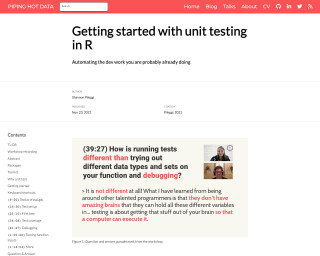
PIPING HOT DATA: Getting started with unit testing in R
Getting started with unit testing in R. This blog post accompanies the R-Ladies Philly workshop on Nov 11, 2021, where they demonstrate how to automate R package testing using the usethis, devtools, testthat, and covr packages. The post highlights key points from the workshop, including strategies for writing tests, debugging techniques, and concepts in function writing that facilitate the testing process.
Go to Resource
Positron Assistant: GitHub Copilot and Claude-Powered Agentic Coding in R
Positron Assistant is a tool that integrates with GitHub Copilot and Anthropic Claude to offer advanced code completion and interaction for R programming. It provides a seamless experience for users switching from RStudio by offering a comprehensive feature set, including remote SSH sessions. With Positron Assistant, users can generate or refactor code, ask questions, get debugging assistance, and receive project guidance within the Positron environment. It simplifies the process of creating R packages, documenting with Roxygen2, and writing unit tests with testthat, demonstrating its capability through agent mode.
Go to Resource

R package workshop
This content outlines the structure and components of an R package development workshop. It includes topics like setting up an environment, writing and documenting functions, version control, and publishing to repositories like CRAN and GitHub. The workshop is aimed at individuals with basic R knowledge and focuses on practical aspects, such as naming packages, creating DESCRIPTION files, managing dependencies, and integrating version control systems. Advanced topics include dataset inclusion and language integration. It is intended for a bioinformatics audience by COMBINE, utilizing bookdown for writing and RStudio for development.
Go to Resource
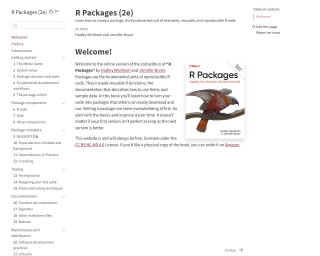
R Packages
Learn how to create a package, the fundamental unit of shareable, reusable, and reproducible R code.
Go to Resource
R packages for chaos control
This content covers R packages and their often underappreciated role in organizing scripts, data, documentation, and reports. R packages are discussed beyond their common association with CRAN, including their usefulness in simpler scenarios. The piece highlights the importance of R packages for consistency, structure, and promoting documentation. Practical applications of R packages, such as creating utility functions and sharing code, are emphasized, especially for collaboration. Version control and GitHub are mentioned as complementary tools. Building an R package is encouraged, with references to resources and a minimal guide to get started, suggesting a less intimidating approach for newcomers.
Go to Resource
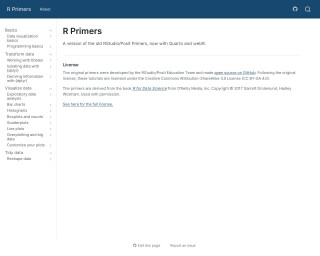
R Primers
R Primers offer updated RStudio/Posit educational content, now utilizing Quarto and webR. Originally developed by RStudio/Posit Education Team, these open-source tutorials help users learn R programming, deriving content from the book 'R for Data Science'. They are licensed under the CC BY-SA 4.0, ensuring wide accessibility for learners to improve their data science skills with R.
Go to Resource