
Resources
This carefully curated collection of resources will help you find packages and learning resources to help you on your R journey.

Recreate Some SAS® Procedures in R Using {procs}
The R package 'procs' replicates commonly used SAS procedures, targeting functions like PROC FREQ, PROC MEANS, PROC TTEST, and PROC REG. It simplifies the transition for SAS users to R by providing familiar functionality and outputs. This includes rich reporting outputs similar to SAS, pre-validated results to ensure fidelity with SAS outputs, ease of adoption for existing SAS users, and stability to maintain backward compatibility. The package includes data manipulation functions and aims to help save time in statistical results comparison and reporting.
Go to Resource
resouRces
This content encompasses a comprehensive list of R-related educational materials, packages, tutorials, and datasets with projected dates ranging up to the year 2025. It includes various titles that focus on learning R programming, data analysis, data visualization, geospatial mapping, and statistical methods. Significant emphasis is placed on resources for learning R, such as introductions to R, books, courses, and video tutorials. Additionally, specific packages for data wrangling, statistical modeling, and visualization are mentioned, indicating the evolution and specialization of R's ecosystem to cater to diverse data science needs.
Go to Resource

Stat545
This is the table of contents for the STAT 545 resource, which covers various topics related to R programming.
Go to Resource
The R Package Workflow
This text describes the R package workflow for structuring data science projects.
Go to Resource
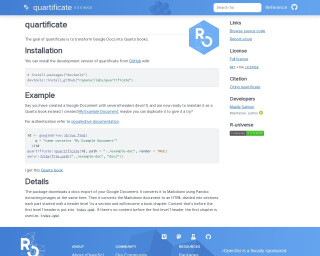
Transform Google Docs into Quarto Books with {quartificate}
The 'quartificate' package is designed to convert Google Documents into Quarto books, facilitating the transition from a simple document to a structured and maintainable book format. It streamlines the process by exporting the document into a Docx file, converting it to Markdown via Pandoc, and then sectioning it into HTML chapters based on header levels. This enables users to easily manage and render their content as a Quarto book. The package also provides seamless integration with Googledrive for authentication and document retrieval, and offers a quick start to render and view the book using the 'servr' package.
Go to Resource
Use SAS, R, and quarto Together • sasquatch
sasquatch is an R package that enables the integration of SAS, R, and Quarto for creating reproducible multilingual reports. It utilizes SASPy and reticulate to run SAS code blocks within R, transfer data between SAS and R, perform SAS client file management, and render SAS output in quarto documents. The package includes installation instructions for development version, Python, and SASPy. It offers functionality such as interactive execution of SAS code, data conversion between R and SAS, and rendering quarto documents with SAS output, distinguishing it from similar packages like sasr, configSAS, and SASmarkdown.
Go to Resource
Use SAS, R, and quarto together with sasquatch
sasquatch is a package that allows the integration of SAS, R, and Quarto to create reproducible multilingual reports. The package facilitates running SAS code blocks, managing data and files across SAS and R, and rendering outputs within Quarto or R Markdown documents. It also provides functionalities for installing dependencies like Python's SASPy, configuring SAS, especially for SAS On Demand for Academics, and managing Quarto document templates for seamless integration with SAS output. Users can pass data between R and SAS, execute code blocks interactively, and render polished documents with familiar SAS styles.
Go to Resource
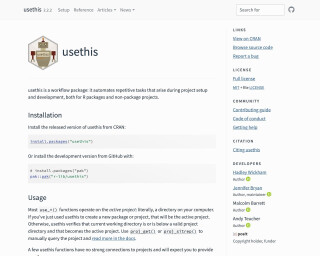
usethis
usethis is a workflow package that automates repetitive tasks that arise during project setup and development, both for R packages and non-package projects.
Go to Resource
Using renv in R
The content is a blog post by Erik Gahner Larsen discussing the use of the 'renv' package in R for managing package dependencies and ensuring reproducibility in R projects. It highlights issues faced when R scripts fail due to package updates or system changes and presents 'renv' as a solution for creating isolated project environments with specific package versions. This ensures that R scripts remain functional over time by snapshotting and restoring package states, thus allowing others to run the code with the intended results, even if the R landscape changes.
Go to Resource
Welcome to ModernDive (v2) | Statistical Inference via Data Science
ModernDive (v2) is the website for 'Statistical Inference via Data Science: A ModernDive into R and the Tidyverse (Second Edition)'. It showcases updates from the first edition, which is available online and for purchase. The book, authored by Chester Ismay, Albert Y. Kim, and Arturo Valdivia, teaches R and data science concepts. It's scheduled for print by CRC Press in 2025 and is licensed under Creative Commons. Readers can contribute on GitHub and anticipate a resource-rich approach to stats with a focus on tidyverse tools for data analysis.
Go to Resource
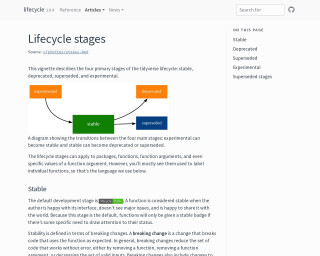
What does deprecated mean? Package lifecycle and the process of deprecation
This content describes the lifecycle stages of the tidyverse ecosystem, including stable, deprecated, superseded, and experimental stages, mainly as they apply to functions. It outlines how the stages affect the usability and changes in functions, with a focus on preventing and managing breaking changes. Emphasis is placed on ensuring code robustness by careful use of functions according to their intended effects. The content also addresses the gradual deprecation process, which provides warnings and guidance for replacing outdated functions, and introduces the 'lifecycle' package for managing these transitions.
Go to Resource
What does deprecated mean? Package lifecycle and the process of deprecation. - YouTube
This YouTube video provides an explanation of the meaning of 'deprecated' and discusses the package lifecycle and the process of deprecation.
Go to Resource