
Resources
This carefully curated collection of resources will help you find packages and learning resources to help you on your R journey.

10 years of rio
This is a blog post titled '10 years of rio' by Chung-hong Chan. It discusses the history and development of the R language package 'rio', which is similar to stringr. The author talks about the motivation behind creating the package and the design principles used. The package provides functions for importing and exporting data in various formats, with a consistent API. The post also mentions the compatibility of the package with older versions of R.
Go to Resource
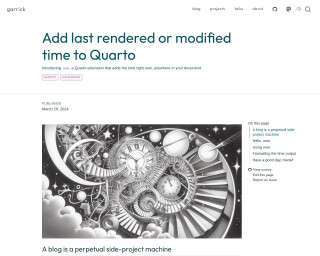
Add last rendered or modified time to Quarto
Garrick Aden-Buie's blog post introduces 'now,' a Quarto extension that allows the automatic update of time information in Quarto documents. This extension saves time by eliminating the need for manual updates of dates in documentation footers. By adding the extension using 'quarto add gadenbuie/quarto-now,' Quarto users can employ shortcodes like '{{< now >}}' and '{{< modified >}}' to display the current or last modified time. The extension supports customization of time output formats and may significantly streamline Quarto project maintenance by ensuring date accuracy without manual intervention.
Go to Resource
Bluesky conversation analysis with local and frontier LLMs with R/Tidyverse
This content details the author's exploration of bluesky conversation analysis using R and the Tidyverse suite, specifically focusing on local and frontier large language models (LLMs). The author leverages R packages atrrr, ellmer in the tidyverse, mlverse/mall, and interfaces with models such as Claude & Ollama. Processes include summarizing posts, performing sentiment analysis, and posting summaries to GitHub via the gistr R package. Techniques include data retrieval, text analysis, and summarization, showcasing how open models can provide insights into community discussions on Bluesky, particularly within the R community's use of the #Rstats hashtag.
Go to Resource
Building a Linkedin data visualisation template with Quarto and Typst
Aaron Schiff shares a method for sharing data visualizations on Linkedin using Quarto and Typst. He created a template that allows for the production of nicely formatted PDFs to circumvent Linkedin's subpar image handling. The template includes a topic heading, summary text, a ggplot chart, data source citation, optional two-column text, and a footer. Additionally, Schiff explains the synergy of Quarto, a publishing system, and Typst, a layout framework, to streamline the production of visually appealing PDFs. He provides guidance on creating a Quarto Typst template and how to use it with example code and the configuration process.
Go to Resource
Building R packages with devtools and usethis | RStudio - YouTube
This YouTube video provides a tutorial on building R packages using devtools and usethis in RStudio.
Go to Resource
Create, scan, and correct exams with R | by Edgar J. Treischl | Medium
This blog introduces the R exams package and shows how to create, scan, and correct student exams using R. It demonstrates how R scans exam images, extracts answers from single or multiple choice questions, and corrects them automatically. It also highlights the next steps and how they are implemented in R, as well as how to create your own exam questions. The package helps automate the entire process of generating, scanning, and assessing exams.
Go to Resource
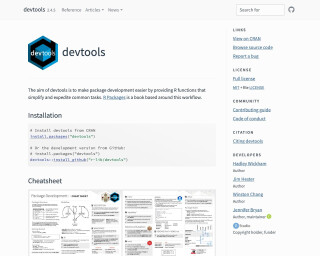
devtools
devtools is an R package that aims to make package development easier by providing functions that simplify and expedite common tasks. It includes functions for loading code, updating documentation, running tests, building and installing packages, checking and releasing packages, and more. It is widely used for R package development and there are several resources available to learn more about package development using devtools.
Go to Resource
Easily download files from the Open Science Framework with Papercheck
The 20% Statistician is a blog focusing on statistics, research methods, and open science. It aims to help researchers understand crucial statistical concepts, claiming that grasping 20% of statistics can improve 80% of inferences. A recent post highlights the challenge of downloading files from the Open Science Framework (OSF). The authors, DeBruine and Lakens, introduced 'Papercheck,' an R package with a function 'osf_file_download' that simplifies this process. Papercheck recreates OSF's folder structure within a local directory, making it user-friendly to access project files for review or reuse.
Go to Resource
For fs – Notes from a data witch
The blog post discusses the 'fs' R package, which provides a cross-platform interface for filesystem operations, replacing base R functions like file.path(). Despite the belief that such a package is boring, the author emphasizes the hidden nuances and pitfalls in seemingly simple tasks like specifying file paths. The post illustrates the benefits of using fs's path() function over paste() to avoid errors in large projects where file paths could become complex to handle. The inclusion of a conversation with the author's alter ego adds humor, portraying the challenge in writing about a technical and unglamorous tool.
Go to Resource
Hadley Wickham @ Posit | Giving benefit to people using what you build | Data Science Hangout - YouTube
A Data Science Hangout interview with Hadley Wickham, discussing the philosophy of giving benefit to people using the tools he builds.
Go to Resource

How to write an R package
R packages are great for organizing your own work and sharing with others. This article provides a step-by-step guide on how to write an R package using tools like devtools, usethis, and roxygen2.
Go to Resource