
Resources
This carefully curated collection of resources will help you find packages and learning resources to help you on your R journey.
Learning R as a SAS user
This article provides valuable resources and tips for learners transitioning from SAS to R. It introduces the Sassy system of packages, which mimics familiar SAS outputs, and offers links to useful cheatsheets and videos for R learners. The author acknowledges the unique challenges faced by former SAS users and organizes tips from data loading to execution advice, catering to various skill levels. The article aims to ease the learning curve and enhance the R programming experience for individuals accustomed to SAS.
Go to Resource
Lotas - AI for RStudio | Rao Code Editor
Rao Code Editor by Lotas is an AI-powered tool designed to enhance the RStudio workflow. It offers an intelligent code editor that understands project files and data, enabling it to generate and edit code efficiently. Rao writes R scripts and R markdown files, fixes errors, and improves analyses. It also comprehensively analyzes output, including console results and data visualizations, providing suggestions and insights into the code's implications. Available with a free tier, Rao aims to streamline the coding process for RStudio users.
Go to Resource
Lots is happening in the LLM/R space!
Veerle Eeftink - van Leemput discusses the rapid development of R and LLM-related software, detailing new packages and tools that integrate Large Language Models (LLMs) with R. She highlights packages that facilitate API calls, context-aware assistance, and NLP tasks without training custom models. Notable contributions from Simon P. Couch and other developers are mentioned, including tools for evaluating LLM performance, error handling, unit testing, and sentiment analysis. The post hints at R's vitality in the LLM ecosystem and includes links to GitHub repositories for further exploration.
Go to Resource
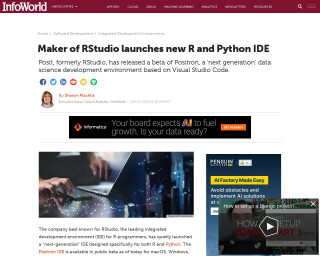
Maker of RStudio launches new R and Python IDE
Posit, previously known as RStudio, released a beta version of its new integrated development environment (IDE) called Positron. Tailored for data science, Positron supports both R and Python programming languages and is based on Visual Studio Code. It simplifies setup for R and Python without needing additional extensions, unlike standard VS Code. Positron includes built-in features like a data explorer for viewing and interacting with data frames. It is available on macOS, Windows, and Linux and integrates with the OpenVSX registry for extensions, highlighting Posit's support for OpenVSX. The IDE emphasizes a code-first approach with additional tools to aid data examination.
Go to Resource
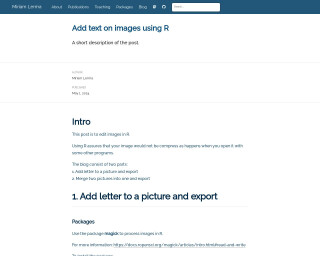
Miriam Lerma: Add text on images using R
This article explains how to add text to images in R and merge two images using the {magick} package. It covers installation and usage of the package, selecting the working directory, and loading images with 'image_read'. The article demonstrates how to annotate images with text at specific locations and export the modified images using 'image_write'. Additionally, it shows how to add a border to images and combine them side by side into a single image before exporting. The guide includes code snippets and is suitable for those looking to edit images programmatically in R without image compression issues.
Go to Resource
Optimising VS Code and Positron for Quarto
This content presents a comprehensive guide to optimizing the editing experience of Quarto documents within VS Code and Positron platforms. It details specific editor settings adjustments aimed at improving document editing by addressing common issues such as code formatting, readability, and workspace performance. The settings enhance visual assistance, reduce visual clutter, manage markdown table rendering, and refine Git diffs. Essential configurations such as defining language-specific settings, modifying word wrapping, and utilizing bracket pair guides are discussed. Additionally, recommendations for visual line length guides, workspace performance optimization, and GitHub Copilot integration for AI assistance are provided to streamline the Quarto document editing workflow.
Go to Resource
Posit Generative AI Solutions
Posit GenAI Solutions offers versatile packages for integrating LLMs into R and Python. It features ellmer and chatlas for LLM communication, shinychat for chatbots in Shiny, and ragnar for Retrieval-Augmented Generation. Additional tools include querychat for natural language data querying, chores for automating coding tasks, and gander for in-line chat integration in data science workflows. The mall package efficiently applies LLM predictions to data frames, while lang translates documentation. Positron Assistant and GitHub Copilot enhance IDEs with AI. Packages like otel provide observability via OpenTelemetry, and mcptools implements the MCP for R sessions.
Go to Resource
Positron IDE - A new IDE for data science
Dr. Mowinckel reviews Positron IDE, a new data science-oriented IDE that's evolved from Visual Studio Code. The blog explores Positron's compatibility with R and discusses its features, such as integration with Rmd, Hugo websites, and RStudio projects. It analyzes the ease of transitioning from other IDEs, like RStudio, highlighting Positron's customizability, multi-language support, and environment setup. Comparisons are made with other IDEs, underscoring Positron's suitability for polyglot programmers and its potential as a preferred tool. The writer reflects on the learning curve and extensibility, giving insights into making Positron an effective data science environment.
Go to Resource
Privacy and AI Assistants
This blog post by Simon Couch and Sara Altman from Posit discusses the integration of privacy concerns with AI assistants. It provides insights into how AI technology, especially large language models (LLMs), can align with privacy standards. Simon Couch, a software engineer with expertise in R and LLMs, shares his experiences in developing packages for R that enhance LLM capabilities. Additionally, Sara Altman, a data science educator, highlights the resources available through Posit for open-source data science. The post emphasizes the importance of privacy in AI as these technologies become more prevalent in data analysis and software development.
Go to Resource
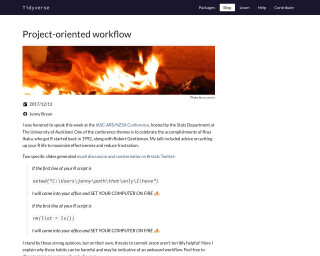
Project-oriented workflow
This blog post discusses the importance of a project-oriented workflow in R and provides recommendations for organizing data analysis into self-contained projects.
Go to Resource
R Best Practices
This post provides a discussion of best practices for developing code-based projects and for writing R code in a research setting with an eye toward proactively avoiding common pitfalls.
Go to Resource
R to Tableau, then show it in Quarto
This content outlines Gregers Kjerulf Dubrow's journey to integrating R with Tableau and showcasing the synergy through a Quarto blog post. Dubrow seeks to enhance his employment prospects by demonstrating his proficiency in Tableau alongside his R skills. Utilizing the free version of Tableau Public and without previous knowledge of data connection and cleaning in Tableau, he adopts a workflow that features using r for sourcing and cleaning the data, followed by visualization in Tableau, and finally embedding the Tableau visualization in a Quarto blog post. This practical application involves a data analysis project of the English Premier League's 2022-23 season with the worldfootballr package, including the creation of a parametrized user-choice analysis dashboard.
Go to Resource