
Resources
This carefully curated collection of resources will help you find packages and learning resources to help you on your R journey.
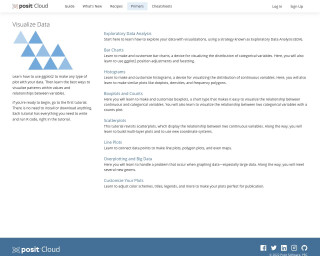
RStudio Cloud Primers: Visualize Data
Posit Cloud is a cloud-based solution that allows users to securely store and access their data from anywhere. It provides data storage, backup, and synchronization services, making it easy for users to access their files and collaborate with others.
Go to Resource
RStudio Projects and Working Directories: A Beginner's Guide
This blog post provides a basic introduction on how to use RStudio Projects and structure your working directories. It explains why RStudio projects are important and the advantages of using them over setwd(). The post also covers how RStudio projects make file paths relative, making it easier to reference files within the project. It includes practical examples and personal advice for beginners in R programming.
Go to Resource
RStudio Shortcuts and Settings
Albert Rapp provides a guide for maximizing productivity in RStudio with shortcuts and settings. This post covers visual adjustments like themes, legibility improvements, and editor configurations, alongside tips for efficient code execution, debugging, and navigation. Rapp emphasizes starting with a clean environment, highlights key shortcuts for coding basics, file searching, command palette, and session management. The aim is to enhance user experience, reduce reliance on the mouse, and improve coding workflow. Ideal for R users looking to streamline their RStudio setup.
Go to Resource
RStudio to Positron
This overview is designed for current RStudio users considering a switch to Positron, a new IDE. It explains similarities between RStudio and Positron and highlights changes users can expect. By leveraging Code OSS, the same foundation as Visual Studio Code, Positron offers features tailored for data science. This guide, alongside additional resources, aims to ease the transition with a focus on keybindings, feature comparisons, and using Positron's user interface effectively. Tips include using the migration guide and exploring the Command Palette, a central element differing from RStudio's traditional layout.
Go to Resource

rtweet
rtweet is an R package that allows for interacting with Twitter's APIs to collect and analyze Twitter data.
Go to Resource

RVerbalExpressions
RVerbalExpressions is an R package that makes it easier to construct regular expressions using grammar and functionality inspired by VerbalExpressions.
Go to Resource
rvest
rvest is an R package that helps you scrape (or harvest) data from web pages. It is designed to work with magrittr to make it easy to express common web scraping tasks.
Go to Resource
Saloni's guide to data visualization
Saloni Dattani of Our World in Data provides a comprehensive guide to creating effective data visualizations. While not R-specific, the principles apply directly to work in {ggplot2} and other R visualization tools. Dattani covers why visualization matters, how to choose meaningful chart types, techniques for making charts clearer (like using horizontal text and direct labeling), and how to avoid common pitfalls like misleading scales and confusing color choices. The guide emphasizes creating charts that work as standalone pieces, are accessible to colorblind viewers, and include proper context and sourcing. Whether you’re creating exploratory visualizations or polished final graphics, this guide offers valuable insights for improving your data visualization work.
Go to Resource

savonliquide
GitHub repository for the savonliquide R package, which provides a toolbox for implementing accessibility-related concepts.
Go to Resource
Second edition of Geocomputation with R is complete – geocompx
The blog post announces the near-completion of the second edition of 'Geocomputation with R.' It showcases the three-year journey of updating and enhancing the content, discussing improvements and pending tasks. This edition integrates changes in the R ecosystem, such as the introduction of the terra package for raster data and sf package's support for spherical geometries. It revises content on spatial vector and raster data manipulation, connects R with GIS/cloud services, and addresses real-world geocomputation applications like transportation and ecology. The second edition aligns with new library standards, emphasizing the practical, hands-on nature of the open-source book.
Go to Resource
Seven tips for creating Quarto revealjs presentations
This content provides practical advice from Dr. Tom Palmer on creating Quarto revealjs presentations, particularly useful for lecturers using images, maths, or code. Tips include slide size adjustments, code chunk formatting, and previewing presentations on different screen resolutions. Quarto's integration with revealjs simplifies the process, and the tips address common hurdles, enhancing the readability and visual compatibility of presentations. For detailed guidance, the Quarto user guide and documentation are recommended.
Go to Resource
sf
Simple Features for R is a package that provides simple features access for R. It represents simple features as records in a data.frame or tibble with a geometry list-column, and interfaces with GEOS for geometrical operations on projected coordinates. It also interfaces with GDAL, supporting all driver options, and PRØJ for coordinate reference system conversion and transformation. Additionally, it supports reading from and writing to spatial databases such as PostGIS using DBI.
Go to Resource