
Resources
This carefully curated collection of resources will help you find packages and learning resources to help you on your R journey.
Iterate parameterised {xaringan} reports
Learn how to iterate parameterised xaringan reports using R. This tutorial demonstrates how to create a parameterised R Markdown template and iterate over parameter values to generate multiple reports with different data.
Go to Resource
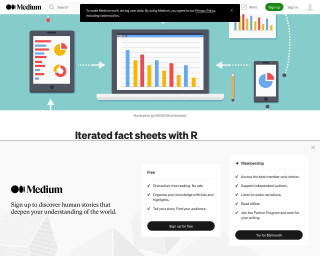
Iterated fact sheets with R Markdown
This article explains how to use R Markdown to create iterated fact sheets. It provides an overview of R Markdown, discusses the necessary ingredients for creating multiple fact sheets, and provides examples using the bad_drivers dataset.
Go to Resource
LA County Population Data Viz
This content outlines a detailed example of accessing and visualizing population data for Los Angeles County using R programming language. It provides insights into the population size of LA County compared to the city proper and the greater metropolitan area. Additionally, the text includes R code that interacts with the U.S. Census Bureau API, demonstrating how to retrieve, filter, and arrange population estimates with county-level granularity and geometry data for mapping. The snippet focuses on data manipulation and visualization techniques using tidyverse and tidycensus, highlighting the practical application of these tools in demographic analysis.
Go to Resource
Lotas - AI for RStudio | Rao Code Editor
Rao Code Editor by Lotas is an AI-powered tool designed to enhance the RStudio workflow. It offers an intelligent code editor that understands project files and data, enabling it to generate and edit code efficiently. Rao writes R scripts and R markdown files, fixes errors, and improves analyses. It also comprehensively analyzes output, including console results and data visualizations, providing suggestions and insights into the code's implications. Available with a free tier, Rao aims to streamline the coding process for RStudio users.
Go to Resource
Mapping water insecurity in R with tidycensus
This content provides a comprehensive guide on utilizing the tidycensus package in R to map water insecurity based on American Community Survey data. It elaborates on setting up the tidycensus environment, exploring Census Bureau variables, and performing data processing. Techniques like data visualization with tigris and sf packages are also covered. The tutorial highlights differences in plumbing facilities and compares population versus plumbing access across Western U.S. counties. With practical code examples, it aids readers in understanding and visualizing the spatial variation of social vulnerability indicators affecting water insecurity.
Go to Resource

Meet xaringan: making slides in RMarkdown
This is a tutorial on how to make slides with R Markdown using the xaringan package.
Go to Resource
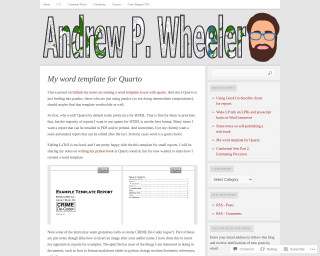
My word template for Quarto | Andrew Wheeler
Andrew Wheeler's blog post discusses creating a custom Word template for use with Quarto, which is beneficial for reports that require formatting suitable for email, printing, or post-generation editing. Starting with the command to generate a default Word template from Quarto, Wheeler explains how to modify styles for various document elements like titles, headings, and code snippets. The template supports markdown tables and features styling for page numbers, headers, and footers. His template also includes personal branding with a hyperlinked logo. The post is a resource for those who prefer Word over HTML or LaTeX for their Quarto-generated documents.
Go to Resource
New, work-in-progress book on spatial data visualization in R
This is an announcement of a work-in-progress book titled Spatial Data Visualization with tmap: A Practical Guide to Thematic Mapping in R, to be published on October 14, 2025. The book is designed for various levels of expertise, from beginners to experienced GIS users and covers the usage of the tmap package in R for creating thematic maps. The online version is currently available, with the first three parts mostly complete, and further chapters in development. The tmap package has seen significant updates in version 4.0, adding features like improved defaults and expanded faceting options. The book is part of the geocompx project.
Go to Resource
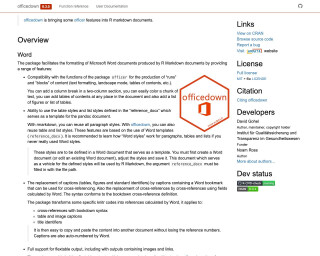
officedown
officedown is an R package that enhances the formatting of Microsoft Word and PowerPoint documents produced by R Markdown. It provides features such as compatibility with the functions of the package officer, the ability to use table styles and list styles defined in a Word template, and support for flextable output. officedown also enhances PowerPoint productions by providing a mechanism for placing results according to a slide template contained in the PowerPoint document. For more information, refer to the package documentation.
Go to Resource
Parameterized Reporting with RMarkdown
Parameterized Reporting with RMarkdown is a tutorial that explains how to use parameterized reporting in RMarkdown to generate multiple reports at the same time.
Go to Resource
Positron IDE - A new IDE for data science
Dr. Mowinckel reviews Positron IDE, a new data science-oriented IDE that's evolved from Visual Studio Code. The blog explores Positron's compatibility with R and discusses its features, such as integration with Rmd, Hugo websites, and RStudio projects. It analyzes the ease of transitioning from other IDEs, like RStudio, highlighting Positron's customizability, multi-language support, and environment setup. Comparisons are made with other IDEs, underscoring Positron's suitability for polyglot programmers and its potential as a preferred tool. The writer reflects on the learning curve and extensibility, giving insights into making Positron an effective data science environment.
Go to Resource

Quarto for Scientists
Quarto for Scientists is an educational material designed to teach scientists how to create reproducible reports using Quarto with R Markdown. It covers installation, workflow, and various features such as figure and table management, equations, bibliographies, and debugging. Initially a 3-hour workshop, it has evolved into a living book, providing a structured learning experience. With Quarto, scientists can integrate code, text, and figures into one file, enabling anyone to reproduce their research with the provided datasets and Quarto files. Nicholas Tierney authored this resource to fill a niche in R Markdown education for scientists.
Go to Resource