
Resources
This carefully curated collection of resources will help you find packages and learning resources to help you on your R journey.
Adding alt text to figures in quarto with Claude Code
The blog post describes a new workflow for adding alternative (alt) text to figures in Quarto documents, leveraging Claude Code, to make the process less tedious and more manageable. It emphasizes the importance of thoughtful alt text creation, details how Quarto's features can be used to extract figure details, and introduces a custom slash command for Claude Code to assist in writing alt text. This command uses Amy Cesal's formula, combining chart type, data description, and key insight into the alt text, utilizing source code and prose context for accurate and informative descriptions.
Go to Resource
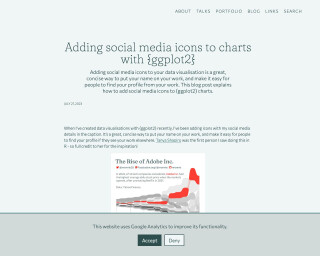
Adding social media icons to charts with {ggplot2}
Adding social media icons to charts with {ggplot2}
Go to Resource

Advanced Reproducible Research in R
This content covers an advanced workshop titled 'Advanced Reproducible Research in R,' designed to teach collaborative and automated analysis pipelines in scientific research. It emphasizes the importance of reproducibility and open scientific practices, presenting solutions to challenges such as coding standards, software dependency documentation, and data analysis automation. The course uses a code-along format with real-world datasets, created with Quarto, GitHub, and GitHub Actions. The material is available on a website and the r-cubed-advanced GitHub repository, licensed under Creative Commons for open use and modification.
Go to Resource
Age Disparity in Shelter Cost per Room
This content details a study on shelter cost per room over time in various regions and age groups in Canada, using Census data as a proxy for housing size. The authors, von Bergmann and Lauster, investigate the increasing shelter costs, particularly for younger people and in areas with housing shortages. They compare these costs with UK statistics on shelter cost per square meter by age and explore the limitations and benefits of using the number of rooms as a metric for household space and costs. The analysis includes data-wrangling using tidyverse and custom functions in R.
Go to Resource
AI capabilities built into Positron
Recorded at posit::conf(2025), this demo showcases practical ways to use the Positron Assistant for tasks like debugging code, generating visualizations, and even creating entire Quarto reports. It also introduces Databot, an experimental agent for exploratory data analysis, demonstrating how these tools can accelerate your workflow while keeping you in the driver’s seat.information, advertising opportunities, and terms of service. It also includes a nod to privacy and safety principles and the operational workings of YouTube. Additionally, it promotes YouTube's experimentation with new features and the service NFL Sunday Ticket. The 2025 copyright date suggests forward-looking engagement with these matters. The content outlines multiple facets of YouTube's online presence and user interface.
Go to Resource
AI-Assisted Clinical Dashboard Development
This article showcases the development of a Clinical Dashboard Prototype using AI-assisted tools within a constrained 48-hour period. The development team faces the challenge of creating a functional PK/PD simulation platform for a stakeholder meeting without enough time for traditional development cycles. By leveraging AI tools like Claude Code, V0.dev, and others, they demonstrate the acceleration of dashboard development. The focus is on the interplay of AI tools to achieve functionality and user experience, reflecting on the strengths and limitations of each tool in the process.
Go to Resource
AI-Powered Data Science in Positron
Positron is a new, free AI-powered code editor by Posit for R and Python, featuring agentic AI capabilities. It was demonstrated by Ryan Johnson, a Data Science Advisor at Posit PBC, who emphasized the tool's ability to simplify data science workflows while keeping the experts in control. Positron is designed to automate tedious tasks, and this demonstration on October 29, 2025 will showcase how AI can enhance productivity without taking over the expert’s role.
Go to Resource
Air 0.7.0
Air 0.7.0 is a newly released version of a powerful R formatter known for its speed, announced by Davis Vaughan and Lionel Henry. It includes updates from versions 0.5.0 to 0.7.0 with enhanced Positron support, a 'autobracing' feature for formatting code blocks, and a GitHub Action for automation. The Air extension comes bundled with Positron, ensuring automatic updates and a seamless experience. The release simplifies adding Air to projects with usethis::use_air(), formatting configuration, and the promotion of consistent coding styles across various editors. It also introduces autobracing for if statements and loops to improve code portability.
Go to Resource
Air, an extremely fast R formatter
Air is an innovative R formatter designed to enhance code readability and maintainability. On February 21, 2025, Davis Vaughan and Lionel Henry introduced Air, boasting exceptional speed in formatting R code. Air automates the styling process, seamlessly integrating with the Positron environment and RStudio. It can reformat individual files on save or entire projects using a terminal command. Key features include instantaneous formatting and smart file recognition to exclude generated files. Air is ideal for tidyverse packages like dplyr and is available as an extension for Positron and VS Code, alongside command line installation options.
Go to Resource
Albert Rapp - Creating interactive visualizations with {ggiraph} (with or without Shiny)
Creating interactive visualizations with ggiraph (with or without Shiny)
Go to Resource

Albert Rapp - Four reasons to learn HTML + CSS as an R programmer
Four reasons to learn HTML + CSS as an R programmer
Go to Resource
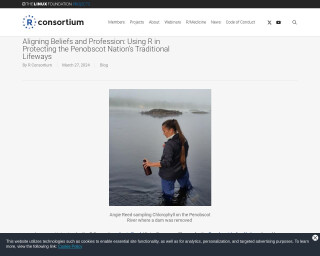
Aligning Beliefs and Profession: Using R in Protecting the Penobscot Nation's Traditional Lifeways
In an interview, Angie Reed, Water Resources Planner for the Penobscot Indian Nation, shares her journey with R, from statistics to river conservation. Beginning with the Houlton Band of Maliseet Indians and later joining the Penobscot Indian Nation, she uses R to blend traditional views with modern technology. This enables engaging community involvement and environmental protection. Her work involves river stewardship, education in R coding, and development of an interactive R Shiny app for the local community, underscoring how R can be instrumental in preserving traditional lifeways and promoting sustainability.
Go to Resource