
Resources
This carefully curated collection of resources will help you find packages and learning resources to help you on your R journey.
Easily download files from the Open Science Framework with Papercheck
The 20% Statistician is a blog focusing on statistics, research methods, and open science. It aims to help researchers understand crucial statistical concepts, claiming that grasping 20% of statistics can improve 80% of inferences. A recent post highlights the challenge of downloading files from the Open Science Framework (OSF). The authors, DeBruine and Lakens, introduced 'Papercheck,' an R package with a function 'osf_file_download' that simplifies this process. Papercheck recreates OSF's folder structure within a local directory, making it user-friendly to access project files for review or reuse.
Go to Resource
Filenames to variables
This content describes a technique for incorporating information from the filenames of multiple CSV files into a data frame during import. The article is by Luis D. Verde Arregoitia and focuses on the scenario where related data is split across multiple files by government agencies, often with key variables only indicated in each file's name. The tutorial demonstrates using the R programming language to group a dataset by several variables, export each group to its own CSV file without the grouping variables but with the naming reflecting those variables, and then re-importing the files while adding the filename-derived information back into the data frame.
Go to Resource
Full-Stack Survey Research with SurveyMonkey • svmkR
This package provides a suite of tools to work with SurveyMonkey surveys in R.
Go to Resource
Generating quarto syntax within R – Notes from a data witch
This blog post introduces 'quartose', an R package designed to integrate with Quarto for literate programming. The author, located in Sydney, discusses the nuances of names and their personal connection to this topic before exploring a data analysis task using the 'babynames' package. The analysis involves mapping names to data frames and visualizing name popularity over time. The post concludes with a demonstration of 'quarto_tabset()' that allows inserting plots or data frames into a document as a tabbed interface, enhancing the presentation of data in a readable and interactive format.
Go to Resource
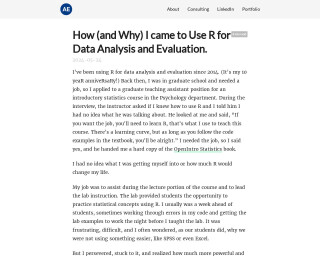
How (and Why) I came to Use R for Data Analysis and Evaluation
Alberto Espinoza recounts his journey with R for data analysis and evaluation, marking his 10-year experience since first encountering R during his graduate assistantship. Initially clueless about R, he was tasked with assisting and leading statistics labs using R. Despite early challenges and a steep learning curve, he recognized R's power over software like SPSS or Excel. His continued use of R spanned graduate projects, market research, data preparation for Tableau, and Survey Monkey analysis. Espinoza outlines R's advantages: reproducibility, efficiency, clarity, and an extensive package ecosystem, underlining R's significance in his professional growth.
Go to Resource
How to open a folder as a Positron project with macOS Quick Actions
Andrew Heiss provides a macOS Quick Action workflow for opening folders as projects in Positron directly from Finder. He details the challenges of transitioning from RStudio's Rproj files to Positron, which lacks an equivalent. To improve efficiency, Heiss introduces an 'Open in Positron' Quick Action and explains the concept of Positron workspaces. He compares them to Rproj files and discusses their pros and cons, offering insights into project-oriented workflows for Positron. Additional details include the integration of project switcher menus, recent project lists, and multi-root workspaces in Positron.
Go to Resource
How to Turn Messy PDFs into Clean Data Frames with R and Elmer
Albert Rapp demonstrates how to use the {ellmer} package to leverage AI models for extracting data from messy PDF files. If you’ve ever struggled with getting clean data out of PDFs, you know how challenging this task can be. This tutorial shows how AI can streamline this traditionally painful process, making it much easier to transform unstructured PDF content into usable data frames in R.
Go to Resource

Introduction to web scraping
Stein Arne Brekke provides an introductory guide to web scraping judicial data in R, focusing on creating a dataset from UK Supreme Court decisions. Emphasizing empirical legal studies, the guide covers data gathering from online sources through programming. It offers a step-by-step process for scraping and organizing data into usable tables for research, using R. Beginners are pointed to additional learning resources, and the guide includes sections on scraping, data management, analysis, and legal considerations. It encourages sharing collected data to aid comparative legal research.
Go to Resource
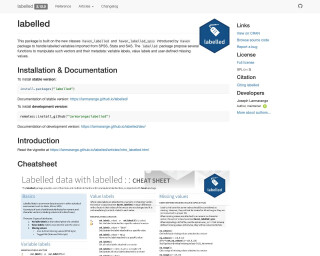
labelled
Manipulating Labelled Data is a package in R that provides functions for handling labelled variables imported from SPSS, Stata, and SAS. It allows for manipulation of variable labels, value labels, and user-defined missing values.
Go to Resource
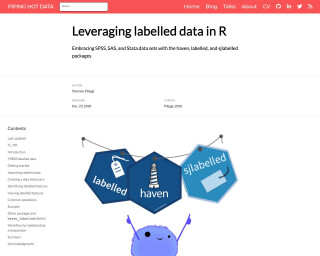
Leveraging labelled data in R
This blog post discusses how to leverage labelled data in R using the haven, labelled, and sjlabelled packages. It covers importing labelled data, creating a data dictionary, identifying labelled features, and common operations with labelled data. The post also provides an example and mentions other packages and workflow for labelled data manipulation.
Go to Resource